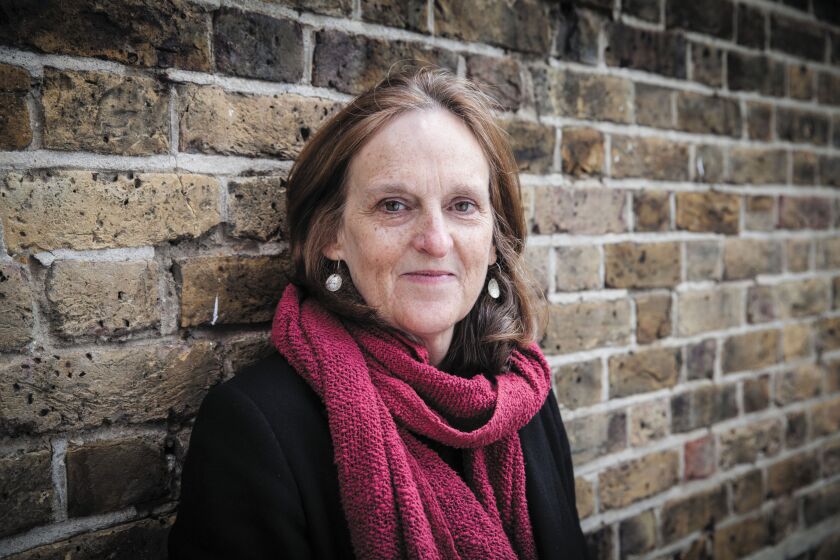
On the Shelf
Free Love
By Tessa Hadley
Harper: 304 pages, $27
For those who purchase books linked on our web site, The Occasions could earn a fee from Bookshop.org, whose charges assist unbiased bookstores.
One 40-year-old housewife’s revolution begins with a kiss in “Free Love,” the eighth novel by British creator Tessa Hadley. In 1967, as a misbegotten banquet winds down in a suburban London yard, Phyllis Fischer kisses Nicky, the younger and insouciant journalist son of household pals, and every little thing modifications. With out hesitation, she abandons her household to stay in Nicky’s London cold-water flat atop a dilapidated constructing of bohemians and immigrants. This act expands into a bigger rejection of social techniques Phyllis finds morally corrupt. However simply as she settles into her new life, a plot twist drives residence the inevitable reality that freedom, notably in center age, comes at a value. For Phyllis, it’s price it.
Melodramatic as this will likely sound, liberation within the Sixties was a seismic occasion, particularly in stiff-lipped Britain. The private upheavals of the period marked a dramatic shift from austere, repressive occasions to the brash, up to date second we nonetheless inhabit.
Consider the scenes across the rooftop live performance in Peter Jackson’s Beatles documentary, “Get Again.” Hadley watched it together with her husband over Christmas. “There are males with umbrellas, expostulating — ‘Can’t we shut them down?’ — as a result of loopy youth with their lengthy hair and their loud music are getting in the best way,” she says over Zoom from her residence in Cardiff, Wales. It was, she remembers, “a pivot on which the subsequent 60 years hold. We stay because the heirs of that second.”
To completely seize its depth, Hadley has made her personal radical shift: She’s written, for the primary time shortly, a linear story inside a finite interval.
Hadley’s latest novels, together with “The London Prepare” and “The Previous,” have been acclaimed for toggling skillfully backwards and forwards in time, the higher to light up sophisticated up to date girls in center age and past. What emerged had been uncommonly clear psychological portraits of the anxiousness surrounding growing older, company, want, creativity and bourgeois life. Alice Munro and Elizabeth Bowen spring to thoughts, as do Lily King and Zadie Smith.
What hyperlinks these works to “Free Love,” for all their structural variations, is an invigorating concentrate on the second half of life, which is when Hadley has produced her most significant work. It has been 20 years since she printed her first novel, “Accidents within the Residence,” at 46. Nevertheless, midlife reinvention tales like Hadley’s are by no means merely the magic of in a single day success.
“In my first 20 years [as an adult] once I was struggling to jot down, I didn’t know learn how to write a ebook that labored,” Hadley says. “A part of the battle was my worry, in these days, that the realist novel of the nineteenth century, which I like to learn, may be useless.” The problem she took a long time to resolve was learn how to meld these realist sensibilities with the fashionable one. Within the twentieth century,” she explains, “we discovered to be extra self-conscious.”
With “Free Love,” she chooses to be direct. The place earlier books relied on an accordion-like manipulation of time, the brand new one goals straight for the bind of center age. Gone are the historic flashbacks of “Late within the Day” and different novels. On this propulsive new work, the previous lives solely via the current.

Phyllis races towards time to flee remorse, seizing a future free from compromise reasonably than capitulating to inertia and regret. She flouts conference to desert one household after which turn out to be a mom once more at 40. Inside the synthetic world of fiction, an imagined lady is liberated with out punishment, although she will not be by any means unscathed. The style of her hard-fought autonomy is as bitter as it's candy.
Her heroine’s success hinges on “a form of foolishness,” Hadley says — and so does the creator’s. “For those who can’t be naive and threat making an enormous idiot of your self, you may solely write guarded, good books. And there’s a spot for them, however they’re ephemeral.” She weighs whether or not it’s “braveness or foolishness that allows a author to be a bit infantile of their books” as a method to offset extreme self-awareness. Finally, she notes, “it’s all the time the interaction between these two opposites.”
Hadley gamely exploits this rigidity in a story that grants the reader sympathy for all its characters — the fearless and hidebound alike. Her feat is all of the extra spectacular at a time when critics overtly choose harsh moms. Contemplate the journalist who lately felt justified asking “Maid” creator Stephanie Land if she ought to have had an abortion.
The theme is in all places. Current works like Dana Spiotta’s “Wayward,” Claire Vaye Watkins’ “I Love You however I’ve Chosen Darkness” and Maggie Gyllenhaal’s movie adaptation of Elena Ferrante’s “The Misplaced Daughter”resonate with up to date audiences who join with ambivalent portraits of motherhood.
But, as Hadley nicely is aware of, this seek for freedom outdoors the nuclear household will not be new. Doris Lessing’s novels on the theme draw on decisions she made starting within the ’30s and ’40s. Hadley latches onto the last decade when this turned doable with out scorn, decided to stay goal all through. “I actually don’t need to take sides about [social] change,” she stresses. “I hope what novels do finest is watch the change.”
In Phyllis, Hadley has created a “lady who will not be sad, not abused, not depressing.” Eradicating judgment, Hadley frees the reader to totally soak up Phyllis’ motivations. That even-handedness applies to all her characters. Hadley observes: “I believe in a novel you might be completely with Phyllis on one web page — really feel, as she says, that each cell of my physique has modified, and she will be able to’t return,” but “additionally agree together with her husband who says, ‘All of us stay in the identical world. How do you suppose you’re freed from these issues?’”
Hadley could get to see yet one more perspective on the story; “Free Love” has been optioned for tv by the Condo, the outfit that produced an adaptation of Ferrante’s “My Sensible Good friend.” Reflecting on her first display possibility, Hadley senses “a beautiful form of relinquishment,” anticipating the liberty “to take action a lot work visually, not spelling issues out however hinting, and seeing.”
This sense of relinquishment — of setting apart cause to take up freedom — is what drives Phyllis and in addition works on her creator in the midst of her late profession: the liberty from having to polemicize and clarify. “The good privilege of the novelist truly — which I imagine fairly strongly — is that at their finest, [one] doesn’t truly must take sides,” she says.
That doesn’t imply relinquishing rigidity or ache. All through this deceptively simple story, an undercurrent of combined feelings tears on the reader. Private liberation will not be a victimless train, however Hadley creates house to see the bigger movement of historical past on the finish of an empire — and firstly of a freer however extra sophisticated period. Brutal however optimistic, Hadley’s arresting novel provides a backward look that helps present us a approach ahead.
LeBlanc is a ebook columnist for the Observer. She lives in Chapel Hill, N.C.
Post a Comment