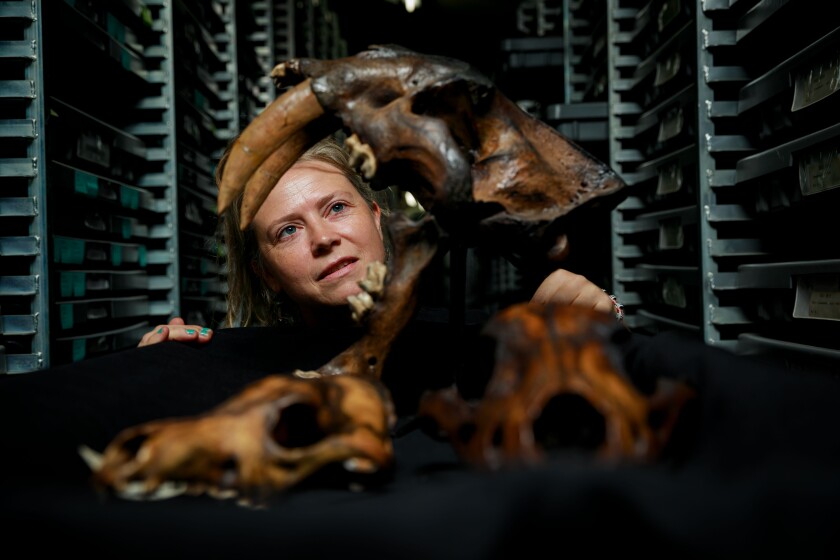
Slender rows of shallow grey bins tower to the ceiling. Resting inside are the jaw bones of saber-toothed cats and historical coyotes that perished within the La Brea Tar Pits as many as 40,000 years in the past.
“The unique Angelenos,” mentioned Aisling Farrell, a collections supervisor at Rancho La Brea. “All the things that now we have lived and died right here, or not less than migrated by way of right here and died right here.”
A number of species of saber-toothed cats went extinct about 10,000 years in the past whereas coyotes survived — changing into the apex predators well-known for terrorizing household pets. The rationale why, argues new analysis based mostly on the La Brea fossils, was the coyote’s superior capacity to adapt to a altering world.
From about 15,000 to 10,000 years in the past — the tip of the Pleistocene epoch — a warming local weather, the growing encroachment of people, or some mixture of each led to an enormous extinction of a few of North America’s largest mammals.
By asking how the survivors responded to the lack of the bigger carnivores, mentioned Vanderbilt College paleontologist Larisa DeSantis, “we are able to start to know what the consequences of previous impacts of local weather change and human results have been in these ecosystems and extract out essential cautionary tales and classes of relevance to conservation right now.”
For instance, she requested, “Did the diets of cougars and wolves and coyotes change in a considerable approach as soon as extinction of those different animals occurred? And in what approach did that truly occur?”

With over 3.5 million fossils representing greater than 600 completely different species, the La Brea Tar Pits would possible maintain the solutions.
“In the event you’re going to check Pleistocene carnivores,” DeSantis mentioned, “you go to La Brea.”
An historical tar seep in the course of modern-day Los Angeles, the La Brea Tar Pits trapped all kinds of animals over the previous 50,000 years. It’s probably the most priceless websites for paleontologists learning each the causes and penalties of species extinctions.
Unwitting herbivores like American bison or large floor sloths that by chance wandered into the sticky lure would cry out for assist, attracting the eye of predators — dire wolves, coyotes, saber-toothed cats, and the uncommon American lion — on the lookout for a straightforward snack. These predators would inevitably develop into caught themselves.

To grasp how these predators tailored to the altering prey availability and the lack of different predators, DeSantis and her collaborators regarded for clues hidden of their enamel: each the chemical composition of the enamel and the bodily scrapes left on the floor.
“All the things you eat is included into your tissues,” DeSantis mentioned. “The wonderful thing about enamel is that the sign is locked in on the time these enamel mineralize.”
Tooth enamel is laid down in adolescence, so it gives a snapshot of what an animal was consuming throughout its young-adult life.
Drilling into the tooth, the researchers eliminated one to 2 milligrams of enamel — an quantity similar to about three grains of sugar.
Crew members from Vanderbilt and New York State Museum in Albany then used mass spectrometry to measure the relative abundance of various isotopes of carbon within the enamel from historical and modern-day carnivores.

Enamel with a better ratio of carbon-13 to carbon-12 point out that their proprietor ate prey that lived in open grassy areas. Enamel with a decrease ratio sign the carnivore hunted in additional coated, forested areas.
The rationale for this distinction is that vegetation that develop in these environments do photosynthesis barely in a different way, resulting in distinctive ratios of carbon-13 and carbon-12. Herbivores that eat the vegetation incorporate their ratio of carbon isotopes into their our bodies, as do the carnivores additional up the meals chain.

In line with the carbon isotope ratios, saber-toothed cats most well-liked to hunt in sheltered groves.
“It is smart then that an ambush predator could be catching extra prey in a extra coated space than in an open plain,” mentioned Julie Meachen, a paleontologist from Des Moines College who was not concerned within the analysis.
Historical coyotes, alternatively, hunted in open areas. However after bigger predators died out, coyotes started catching prey in additional forested areas, their tooth enamel revealed.
This shift was even clearer when the researchers regarded on the bodily put on and tear on the animals’ enamel.
Utilizing a way referred to as dental microwear texture evaluation, “we scan that floor in three dimensions, very similar to a topographic map,” DeSantis mentioned.
Peter Ungar, a paleoanthropologist on the College of Arkansas and the inventor of dental microwear texture evaluation, defined that meals depart attribute marks on the enamel.

If the predator is consuming “the organs and the meat, however not the bone, then they need to have microwear dominated by fantastic parallel scratches,” he mentioned. But when they're consuming quite a lot of bone, they’ll have “quite a lot of pits on their enamel.”
The researchers discovered that earlier than the Pleistocene extinction, each saber-toothed cats and coyotes have been chowing down on the fleshy, meaty components of their prey.
However enamel from coyotes discovered within the tar pits after the Pleistocene extinction have been far more pitted and complicated, indicating that that they had shifted to a extra scavenging conduct — a attribute of coyotes alive right now. (Certain sufficient, the enamel of modern-day coyotes have been additionally fairly pitted.)
In different phrases, DeSantis mentioned, the animals “have been capable of adapt.”
The findings have been printed this month within the journal Present Biology.
“It’s a very attention-grabbing research,” mentioned Ungar, who praised the group for utilizing a number of sorts of proof to make their case. “I feel that’s the way forward for this sort of work.”

It’s not but clear why the saber-toothed cats and dire wolves couldn’t modify to the altering ecosystem in addition to the coyotes did. Maybe these bigger predators had develop into too specialised, DeSantis mentioned.
“If you're smaller, in case you are a generalist, in case you are opportunistic, you will have a greater likelihood at surviving,” she mentioned.
Understanding the coyotes’ response to the disappearance of enormous predators will information researchers as they consider how different species would possibly react to future extinction occasions.
When constructing fashions for a way species might change in response to local weather change and human inhabitants progress, “you must make the idea that what the animal does right now, an animal will do tomorrow,” De Santis mentioned. “However as we’ve discovered from the coyotes, that’s not all the time the case.”
Post a Comment