
Akemi Leung knew her grandfather had been incarcerated at Coronary heart Mountain in Wyoming throughout World Battle II.
However he by no means spoke a lot about it.
Solely when she learn and watched a video of his testimony at a congressional fee listening to did she study extra about what he suffered as considered one of greater than 120,000 Individuals of Japanese ancestry compelled to go away their properties and dwell in focus camps.
“I simply knew him to be a quiet one that favored to look at greater than speak,” Leung mentioned. “Seeing the testimony helped illustrate how he was a pacesetter.”

The listening to occurred many years in the past. By the point she watched the tape in 2017, her grandfather, Hiroshi Kamei, had already died.
With the eightieth anniversary of President Franklin Roosevelt’s Govt Order 9066, which approved the incarceration of Japanese Individuals as a supposed menace to nationwide safety, the ranks of survivors are thinning.
Many went to their graves with out sharing their experiences with their households.
As Japanese Individuals mourn the passing of a era, they're making an attempt to protect the reminiscence of what their elders went by, typically utilizing trendy expertise like podcasts and digital actuality.
The trouble is particularly necessary at a time of rising hate crimes towards Asian Individuals and pushback in some locations towards educating college students about racial injustices, some say.
“Each era has to rediscover the story, perceive it and inform it in their very own method,” mentioned Tom Ikeda, the founding govt director of Densho, a nonprofit in Seattle educating the general public in regards to the Japanese American incarceration.
At Densho, Ikeda and his employees spent many years gathering oral histories.
Now, with just a few thousand survivors left, the main target is shifting to methods to inform these tales creatively, Ikeda mentioned.
In 2020, Densho launched a podcast, “Campu,” from the angle of a brother-sister duo speaking about their great-grandparents.
The group additionally helped create an exhibit on the Bellevue Arts Museum in Washington, with Japanese American farmers describing their incarceration by augmented actuality on guests’ smartphones.
Facial recognition, machine studying and knowledge scraping could also be in Densho’s future, Ikeda mentioned.
On the Japanese American Nationwide Museum in Little Tokyo, a survivor who additionally served within the U.S. Military’s 442nd Regimental Fight Staff speaks with guests.
The survivor, Lawson Sakai, died in 2020. However the earlier yr, the museum had recorded him answering greater than 1,000 questions.
With the assistance of synthetic intelligence, a lifelike video picture of him responds appropriately to guests’ queries.
The AI survivor exhibit was modeled after a related one on the Holocaust Museum Los Angeles.
The Jewish group faces related challenges of preserving reminiscences as fewer and fewer survivors stay.
These displays are “about inquiry, utilizing expertise to supply a method into an interrogation of the testimony that permits folks to be curious,” mentioned Kori Avenue, govt director of the USC Shoah Basis, which created the exhibit.
The “wow” issue of latest expertise appeals to youthful generations. However merely displaying historic artifacts, like these from the lifetime of a Japanese American teenager killed in fight in Northern Italy in 1945, is necessary, too, mentioned Clement Hanami, JANM’s artwork director and vice chairman of exhibitions.
“As a museum, actual objects for us are crucial,” Hanami mentioned. “Trauma of the entire expertise is a fragile factor, and it may be overshadowed by the spectacle. ... It’s necessary for us that the analog will not be neglected by the leisure.”
Activists additionally wish to make sure the preservation of the ten focus camp websites in distant places across the western U.S.
They notched a victory this week when the U.S. Senate voted to designate Camp Amache in Colorado as a historic website. The invoice nonetheless must be authorised by the Home and signed by President Biden.
“The importance is that we're transferring towards telling a fuller story of our nation,” mentioned Tracy Coppola, the Colorado senior program supervisor for the Nationwide Parks Conservation Assn. “Simply realizing the Amache website shall be protected in perpetuity, for the present and future generations, brings lots of hope to our nation.”
In Northern California, a proposal to fence off the Tulelake Municipal Airport has activists up in arms.
The airport is constructed on the positioning of a camp for Japanese Individuals who didn't swear loyalty to the U.S., and the activists wish to relocate it. The fence is designed to maintain out wildlife however would additionally deter guests.
“We really feel like this might be equal to placing a fence round Gettysburg,” mentioned Barbara Takei, a member of the Tule Lake Committee.
Preserving the legacy of the incarceration and educating folks about it stays an uphill battle at instances. Bruce Embrey, who chairs the Manzanar Committee, worries in regards to the controversy over crucial race principle.
If faculty districts ban classes in regards to the nation’s racist previous, lecturers won't be capable of focus on the Japanese American incarceration and its legacy.
“It’s one factor for the victims not to discuss it,” Embrey mentioned. “It’s one other factor for the U.S. authorities’s schooling system to fully whitewash what they did.”
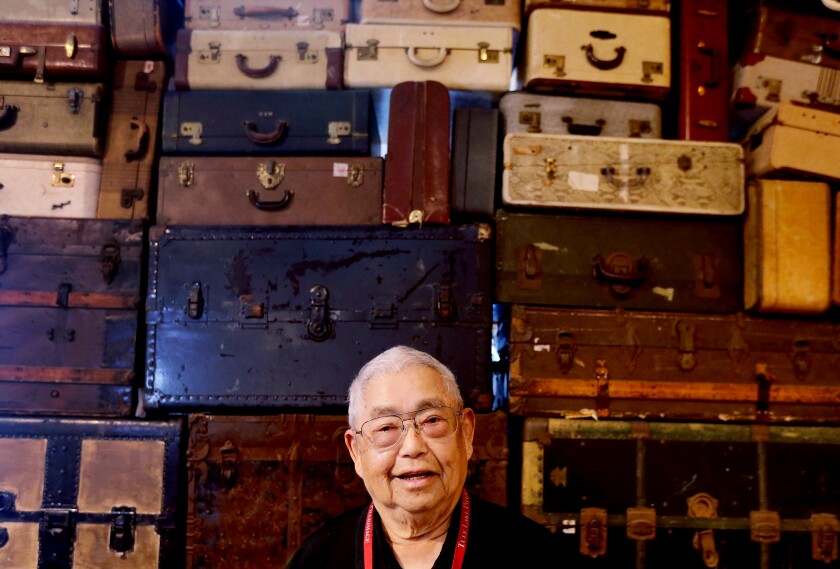
For Richard Murakami, 90, who was 10 when he arrived on the Tule Lake incarceration camp, the traumas his household stored hidden have nonetheless been rising in recent times.
In 2016, his brother Dan advised him a few go to to Tule Lake with their mom many years in the past.
She by no means talked about their time on the camp. She didn’t need her sons to develop up with prejudice towards anybody.
However once they reached the positioning of the camp that day in 1952, Dan recounted, she began crying and couldn't cease.
“Seventy-one years after camp — this was the primary time I discovered my mom led a tricky, sad life whereas we had been incarcerated,” Richard Murakami mentioned.
Post a Comment