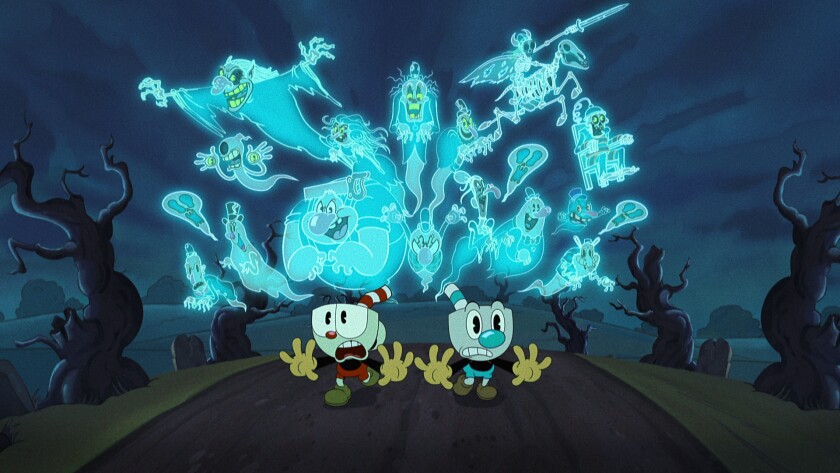
The opening shot of “The Cuphead Present!” is of a teapot-shaped cottage within the woods. Simply outdoors the cottage are a goat and flowers dancing alongside to the upbeat background music. A few butterflies flutter by.
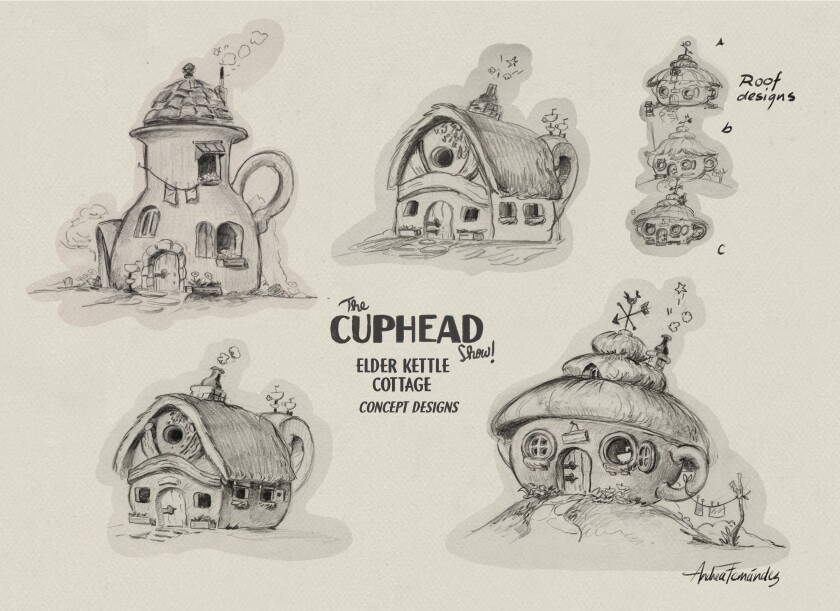
The transient scene-setter is notable as a result of it includes 2D animation tracked over a 3D-sculpted miniature background, in what is called the stereoscopic rotary course of.
“It’s one thing that’s been dormant for many years, and to get to do issues like that as any individual who works in animation [now], we savor each second of it,” mentioned “The Cuphead Present!” artwork director Andrea Fernandez.
“It’s painstaking and it’s costly; that’s why it’s not achieved anymore,” defined govt producer Dave Wasson, who developed the Netflix animated sequence. “Nevertheless it’s such a signature of these Nineteen Thirties cartoons. The Fleischers invented this course of. [We said], ‘If we’re doing a Nineteen Thirties present, it has to have that.’”
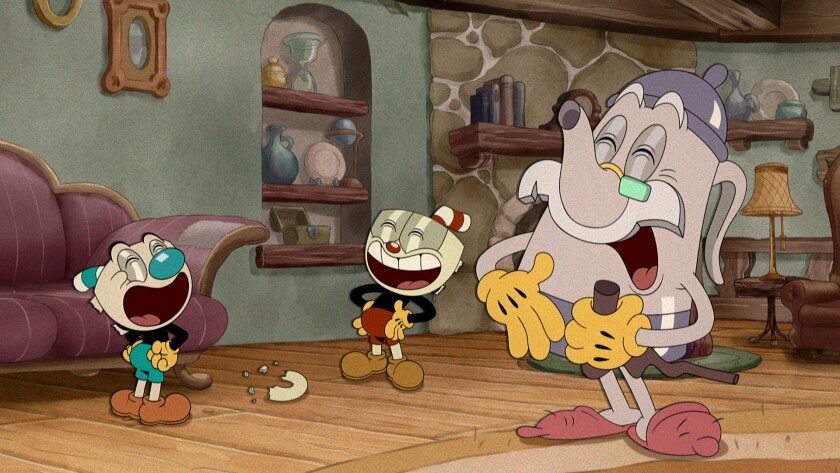
Debuting Friday on Netflix, “The Cuphead Present!” relies on the hit 2017 run-and-gun online game “Cuphead.” Created by brothers Chad and Jared Moldenhauer of Studio MDHR, the fast-based motion recreation is understood for its problem in addition to its solid of characters and its classic cartoon seems to be.
The animated sequence follows brothers Cuphead and Mugman — the playable characters of the unique recreation, named for the drinkware that make up their heads — and their adventures on the Inkwell Isles. Moreover using stereoscopic animation, the sequence attracts upon the touchstones of Nineteen Thirties cartoons and has tailored them for each fashionable audiences and the present TV animation pipeline.
The unique “Cuphead” recreation was born of the brothers’ love for the surreal and experimental hand-drawn cartoons of the Nineteen Thirties, together with Walt Disney Productions’ “Foolish Symphonies” and the works of Fleischer Studios. The animated adaptation — for which each Moldenhauers function govt producers — marks a full-circle journey within the medium that impressed them.
“‘The Skeleton Dance’ by Disney has been burned into my thoughts from a really younger age,” mentioned Chad Moldenhauer. “We rewatched that a ton all through our life. The Fleischer sequence, all of these things, we discovered it so unbelievable. Again in that period of animation, they didn’t fairly perceive the delicate nature of appearing, which is a profit as a result of [the animations are] wild and all over. We had been at all times drawn to it — one thing about it simply had that additional sparkle.”
Jared Moldenhauer credit the brothers’ affinity for these classic cartoons to grocery retailer discount bins that made them accessible within the type of VHS tapes.
“We ended up having a small handful of ‘Foolish Symphonies’ and outdated Fleischer and ComiColor cartoons, which simply caught with us greater than … ‘He-Man’ or ‘Ninja Turtles,’” he mentioned. “We simply discovered ourselves at all times coming again to those outdated tapes we had.”
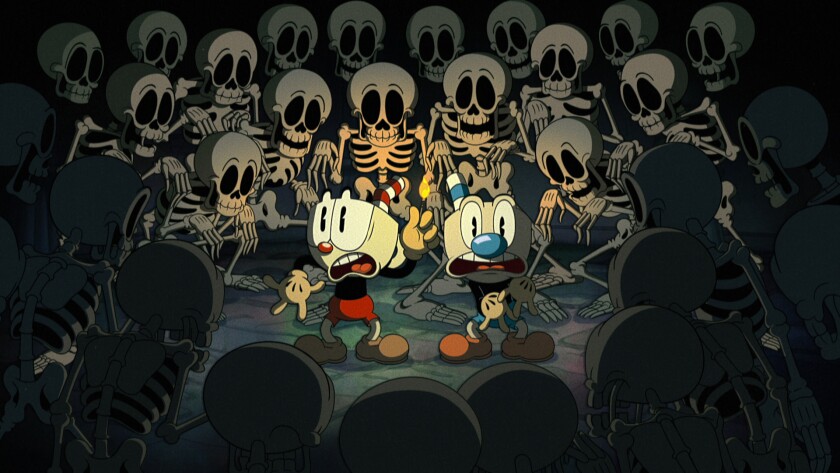
Among the many hallmarks of Nineteen Thirties cartoons that also delight the Moldenhauers are the vitality of free, rubber-hose characters and the disregard for the principles of physics in service of a gag.
“One other a part of what I like concerning the outdated cartoons is there was at all times only a trace of nightmare to it,” mentioned Jared Moldenhauer. “It wasn’t a horror present, however they didn’t have the constraints of questioning what youngsters would assume. … It’s simply that trace of eerie. It’s like probably the most joyful nightmare you possibly can have, basically.”
All these components are channeled into “The Cuphead Present!”
The brothers recall exhibiting their movies to their associates after they had been youthful and studying lots of them had by no means seen that model of animation earlier than.
King Options president CJ Kettler, who additionally serves as an govt producer on the sequence, sees “The Cuphead Present!” as a development of the Moldenhauers’ expertise sharing classic animation by means of these VHS tapes and the “Cuphead” online game.
“We’re going to do the very same factor with the sequence as a result of there’s a complete era of children who’ve grown up with CGI, and so they don’t essentially have the identical degree of appreciation for this extremely stunning, looks-like-hand-painted animation,” mentioned Kettler. “And now this era of children will see it for the primary time and go, ‘Oh, my God, I’ve by no means seen something like that.’ I believe it’s thrilling to have the subsequent era get turned on to it.”
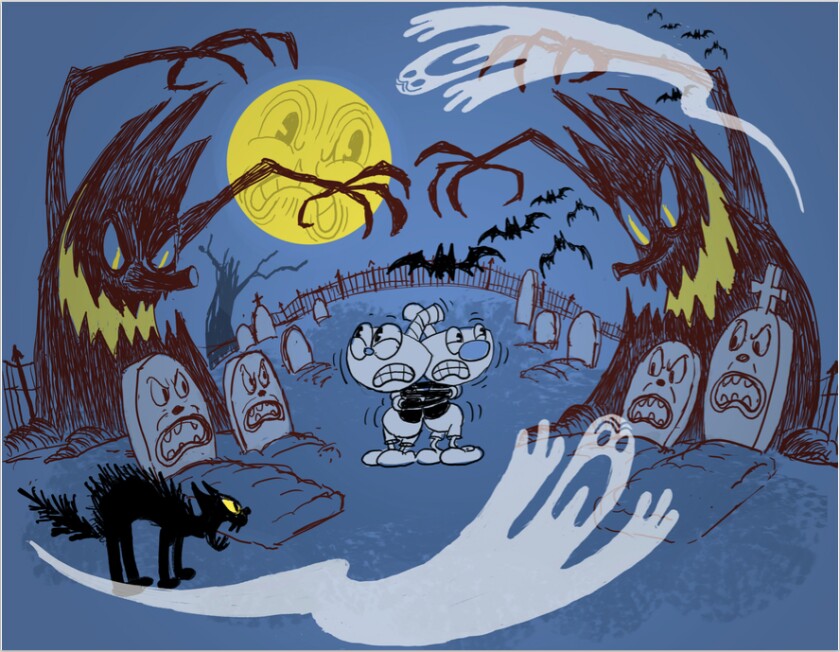
Past the variations between the 3DCG animation that dominates movies and the 2D animation seen extra usually on TV, fashionable instruments and pipelines imply 2D animation is made in a different way now than it was within the Nineteen Thirties.
However the aim on the present, mentioned Wasson, was “to attempt to make it look as very similar to a cartoon that might have been produced again at the moment.”
For character animation, this concerned supplementing a whole bunch of “particular poses” or distinctive illustrations to the animation software program used for the present so the 2D character puppets look as very similar to conventional animation as doable.
“I believe individuals are inclined to overlook the pipeline to supply that look simply doesn’t exist anymore,” mentioned Fernandez. The Nineteen Thirties was “like probably the most formidable time in animation — individuals had been simply going at it. You had painters who had been coming from these prestigious portray faculties and illustration faculties now studying learn how to do animation. To re-create that degree of artwork was really actually daunting and troublesome for a contemporary TV pipeline.”
Determining the look of the sequence concerned an extended research-and-development course of, finding out how animation was made throughout a decade that spanned from black-and-white cartoons to Disney’s “Snow White” (1938). It was a process that concerned not solely synthesizing a mode that felt prefer it was born of that period but in addition making it one which could possibly be sustainable for the individuals engaged on the present and that will enchantment to a contemporary viewers.
Fernandez defined there was lots of trial and error, and he or she discovered that there have been no actual shortcuts.
Re-creating the luxurious, vibrant seems to be of the classic watercolor backgrounds, for instance, concerned the identical technique of portray layer by layer as would conventional portray. The one actual distinction was that it was achieved utilizing digital instruments slightly than paper.
“The artistic course of is definitely virtually precisely the identical,” mentioned Fernandez. “The artist is identical, it’s coming from the identical place. The time, the labor, the love — it’s all the identical in that respect. It’s simply our instruments have been up to date.”
Even the stereoscopic animation concerned some adaptation and studying as a result of it’s a method the staff didn't have expertise with. Working with stop-motion animation specialists from the L.A.-based Display Novelties, “The Cuphead Present!” creatives had to determine learn how to observe the 2D animation onto the sculpted 3D background units.
“The very last thing you need is a personality to be strolling and the background sliding below their toes,” mentioned Wasson. “It breaks the phantasm if it doesn’t seem like they’re really planted within the surroundings. All of us realized making this present — even those that had been the specialists.”
Moreover the instruments and pipeline, one of many largest variations between the Nineteen Thirties and now could be the sensibilities of recent audiences. Whereas audiences within the Nineteen Thirties could be wowed simply by seeing a drawn character shifting, audiences now require extra storytelling components, like interesting characters and comedic timing, to fall into the thrall of a present.
“The animation model sort of developed on us,” mentioned Wasson. “After I began, I [thought] we had been going to do rubber-hose animation and actually keep on with that. However what I shortly got here to comprehend is we’re doing character-driven tales, so we'd like these characters to have the ability to act and have expressions and feelings that you would be able to learn.”
And although the character and background designs are closely influenced by classic cartoons, “you don’t need to know something concerning the Nineteen Thirties” to benefit from the present, he mentioned.
“It’s not like we made this present that’s [just] for animation students,” mentioned Wasson. “In the event you don’t know something about it and also you similar to humorous photos, you possibly can nonetheless watch [the show]. Hopefully it is going to introduce a complete new era of viewers to this model.”
Post a Comment