
BEIJING —
Lime-green buses, momentary buildings and volunteers braced in opposition to zero-degree wind whipping off the Xiaohaituo Mountain Space are scattered across the desolate parking zone that served as an vital waystation for brand new arrivals on the Winter Olympics.
On one aspect of the sprawling lot, cordoned off by waist-high boundaries and assisted by employees in white hazmat fits, athletes modified buses from Beijing Capital Worldwide Airport for the ultimate leg of their journey into the mountains.
When the final athlete boarded the bus on the Banquan Service Space, employees methodically sprayed all the lot with disinfectant. Even sections removed from the bus have been doused. Then the employees sprayed one another.
For anybody who noticed the scene from a bus window, it might be clear that these Video games can be not like something they'd seen.
Nearly 3,000 athletes have been unfold between villages in three clusters, a part of the bubble that severed the 17-day occasion from the remainder of society to forestall the unfold of the coronavirus. The athlete expertise has featured the great occasions and perks anticipated at each Video games — and introduced vital challenges amid strict precautions mirroring China’s zero-tolerance strategy to the pandemic.
“It was arduous,” mentioned Jamie Anderson, the three-time Olympian snowboarder who's a part of the U.S. group of greater than 220 athletes. “We’ve been right here for thus lengthy. I really feel that the entire crew was over it, like simply barely hanging on by a freaking strand of hair. Uninterested in the meals. Homesick. Uninterested in the stress. A bit bit tapped out. I’m excited to go house.”
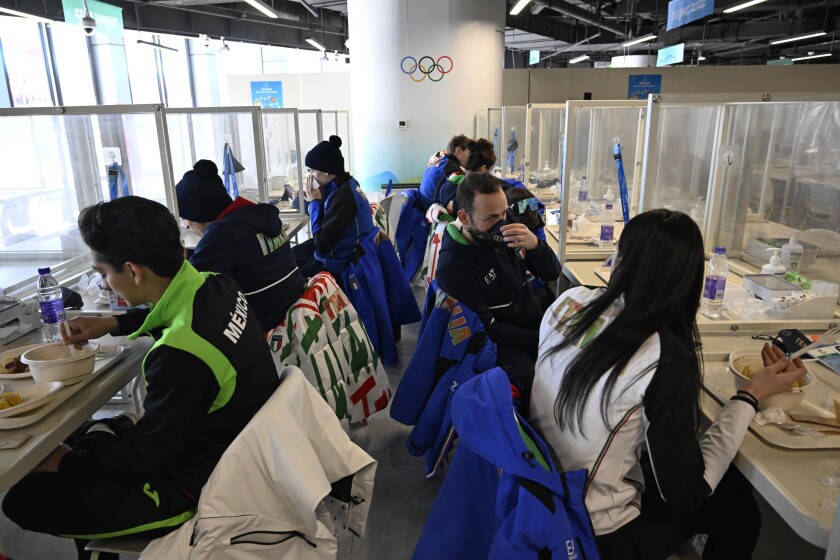
Freestyle skier David Smart, one other three-time Olympian who was one of many ultimate arrivals, referred to as the village his favourite of those he’s been in.
“It's a very closed-loop bubble that we live in, however that's one thing we’ve been coping with all season lengthy,” Smart mentioned. “If something, it appears like we have now extra freedom as a result of the bubble we're in is on such a large scale.”
Among the highlights to passing time within the village embrace a preferred first-person-shooter digital actuality sport that has left gamers in hysterics as they stumble across the sport room with goggles on, adjustable beds with so-called zero-G mode that adjusts the angle, and high-tech reveals exploring conventional Chinese language drugs.
“We’re so attached right here,” U.S. freestyle skier and first-time Olympian Colby Stevenson mentioned. “It’s simply been a loopy expertise. I’ve by no means been to China earlier than so it undoubtedly exceeded my expectation.”
The precautions, nonetheless, permeate each side of every day life as a lot because the always-present employees in hazmat fits. Like everybody else within the bubble, athletes have to be examined every day for the coronavirus, put on high-quality masks once they go away their rooms, try to apply bodily distancing, solely journey between a restricted checklist of accepted locations, monitor their well being although a smartphone app and, when of their cafeteria, use plastic gloves and sit at tables with dividers between every house.
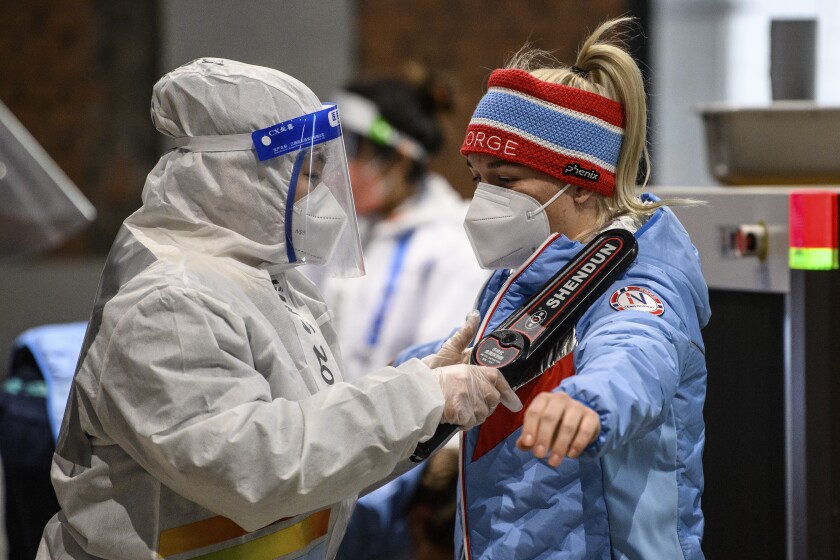
These guidelines additionally apply to high-profile athletes like U.S. Alpine skier Mikaela Shiffrin and her boyfriend, star Norwegian skier Aleksander Aamodt Kilde. Each are staying within the village on the base of the Yanqing Nationwide Alpine Centre, however must preserve their distance aside from sharing divider-separated meals.
“I really feel like they’ve considered every little thing from a sanitation and disinfection standpoint,” mentioned Shiffrin, the three-time Olympian who had beforehand steered away from athletes’ villages due to the potential for sickness to unfold. “I didn’t know what to anticipate. Nevertheless it’s been a pleasing introduction to village dwelling.”
Many of the athletes are accustomed to limits after nearly two years of pandemic-related protocols.
“Everyone says, ‘Yeah, now you possibly can spend a lot time collectively,’ and it’s good to have her, but it surely’s more difficult,” Kilde mentioned. “With COVID and restrictions, you must be actually cautious. … It’s a tease sort of, if what I imply. You see her, however you possibly can’t actually contact her, can’t actually be along with her that a lot. Nevertheless it’s very nice to have her right here.”
No alcohol might be purchased within the village, forcing athletes to navigate the cumbersome transportation system to purchase it at bubble inns and convey it again.
For some it wasn’t a difficulty. U.S. downhiller Bryce Bennett joked that after teammate Ryan Cochran-Siegle gained a silver medal within the super-G, they'd most likely learn and switch in early to rejoice.
Some South Korean speedskaters complained in regards to the meals of their cafeteria on the Beijing village and turned to consuming boxed meals supplied by their nation’s Olympic committee, because it has accomplished at previous Video games. The problem made its solution to the every day information convention held by organizers and the Worldwide Olympic Committee.
In a transcript, the unique query in regards to the South Korean issues had been rephrased to asking in regards to the complexity of making a menu for a various group of athletes.
Qianfan Shen, director-general of the village planning and operation division, responded that organizers “didn’t totally perceive the complexity of the work” and “generally we joke amongst ourselves that [athletes] eat with calculators of their fingers” due to dietary necessities distinctive to their sport and coaching regime.
He identified that in a latest lunch hour athletes consumed 80 roast geese “and after athletes tasted the roast duck, they've been posting movies and pictures on social media.”
The comment underscored native sensitivity to how athletes talk about their lodging. On latest nights, two Chinese language newscasts featured prolonged segments about optimistic social media responses to the villages by athletes.
When U.S. luger Summer season Britcher posted a TikTok video praising the beds within the villages in comparison with these in Tokyo on the Summer season Olympics, the state-run Xinhua Information Company described the video as having gone viral.
Not the entire responses have been glowing. Slovakia’s chef de mission, Roman Bucek, described “huge issues” at three villages that included “an issue with a shower, with cloths, with sewage.”
The situations at isolation amenities for folks contained in the bubble who check optimistic for the coronavirus have been the most important flashpoint within the athlete expertise, heightened by the fact that the virus may knock somebody out of an occasion they’ve educated 4 years to compete in.
A number of nations — Belgium, Germany and the Russian Olympic Committee amongst them — expressed issues in regards to the amenities the place their athletes have been remoted. Chun Huang, deputy director-general for the pandemic response on the Video games, acknowledged “we can't be complacent and proceed to try to make enhancements” to isolation situations.
The precise variety of athletes who've examined optimistic isn’t recognized, however organizers have reported instances from 184 athletes and group officers.
In a single instance, Valeriia Vasnetcova, a biathlete who had been scheduled to compete for the ROC, posted a photograph on Instagram of a meager meal in isolation alongside with a heartfelt plea.
“My abdomen hurts, I’m very pale and I've enormous black circles round my eyes,” she wrote. “I need this to finish.”
The account has since been turned non-public.
Post a Comment