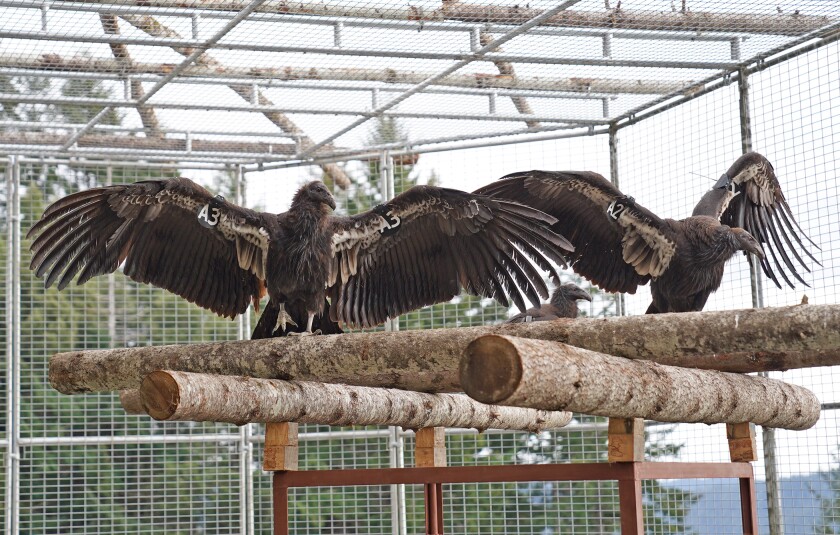
After being pushed to the brink of extinction, California condors have returned to a slice of Northern California habitat for the primary time in 130 years. On Tuesday, 4 of the massive birds flew the coop after being born in a captive-breeding program.
A livestream from the Yurok Tribe and the Redwood Nationwide and State Parks went reside at 8 a.m. however the birds didn't appear too bothered by their schedule. The New World vultures chosen for the momentous event betrayed little on whether or not they would take flight from their designated staging space in Northern California close to the Klamath River.
On Tuesday morning, Yurok Wildlife Division Director Tiana Williams-Claussen, a Yurok citizen and conventional tradition bearer, narrated the occasion in hushed tones close to the birds’ pen.
“I'm simply overjoyed on at the present time,” Wiliams-Claussen whispered to the a whole bunch of viewers over the livestream.
“I do know you like condors as a lot as I do,” she stated. “Proper now, it’s only a ready sport.”
Within the morning gentle, the birds stretched their wings, which might attain as much as 9½ ft, and groomed each other in an intimate huddle. They dined on a carcass after which perched atop their pen in a staging space.
The chat field within the Fb feed exploded with exclamation factors and emojis because the birds approached a entice door that led to the ultimate pen earlier than their launch. Two male birds, merely marked A2 and A3, had been the keen ones that made their technique to the world. Williams-Claussen stepped away from the stream simply after 10 a.m. because the birds had been let loose. One final time, the birds stretched their wings and with none instruction flew into the air.
“That was simply as thrilling as I believed it could be,” Williams-Claussen stated when she returned to her laptop. “These guys simply took off.”
She added, “I'm simply so glad and proud to be right here at the moment.”
The transition to the wild comes after a lifetime raised in captivity for the condors, the place they discovered to stretch their wings in massive flight pens. Biologists discuss with the scavengers as social birds that choose up their life expertise from elders. This specific group was raised with an older hen, which acts as a type of lifetime mentor for younglings in captivity.
Related releases in Arizona have launched the condors again into the wild. The birds are thought of a nonessential, experimental inhabitants underneath the Endangered Species Act.
4 condors, three males and one feminine, had been chosen for the California launch on Tuesday from a newly constructed facility inside the Yurok ancestral territory. The Yurok phrase for condor is prey-go-neesh and the tribe views the hen’s reintroduction as a part of its “obligation to convey steadiness to the world.”
“We’ve been working towards these releases for 14 years,” Williams-Claussen stated in an announcement. “Now, the condor is coming house.”
Two extra birds will likely be launched at a later date.
Biologists will proceed to observe the birds within the wild to ensure they’re adapting to their new environment. The birds vary between 2 and 4 years outdated and had been raised at a facility in Idaho. They first arrived in California in September and are the product of greater than three many years of captive breeding geared toward rescuing the California condor from extinction.
In the course of the Gold Rush within the 1840s, the birds had been shot for sport and picked up for museums. They had been one of many first species positioned on the endangered species record and continued to endure by the Nineteen Fifties when artifical developments crowded their habitat and the pesticide DDT, now banned in the US, weakened the condors’ eggshells, making them brittle and frail.
By the Nineteen Eighties, the wild condor inhabitants dwindled to only 22 birds. In 1983, the U.S. Fish and Wildlife Service launched the primary captive-breeding packages on the Los Angeles and San Diego zoos. In the present day there are roughly 300 condors flying within the wild in California and there are a number of launch amenities throughout the area, in keeping with federal officers.
Tuesday’s launch marked an important day for biologists working along with the Yurok Tribe, the Ventana Wildlife Society and the Northern California Condor Restoration Program.
“The reintroduction of condors into Northern California is actually a monumental second,” stated Paul Souza, director of the U.S. Fish and Wildlife Service’s Pacific Southwest area. “This effort builds upon this system’s collective information and historical past of releasing condors and showcases the advantage of partnering with Tribes and others to implement restoration of listed species. We're proud to help this collaborative to implement restoration of listed species.”
Post a Comment