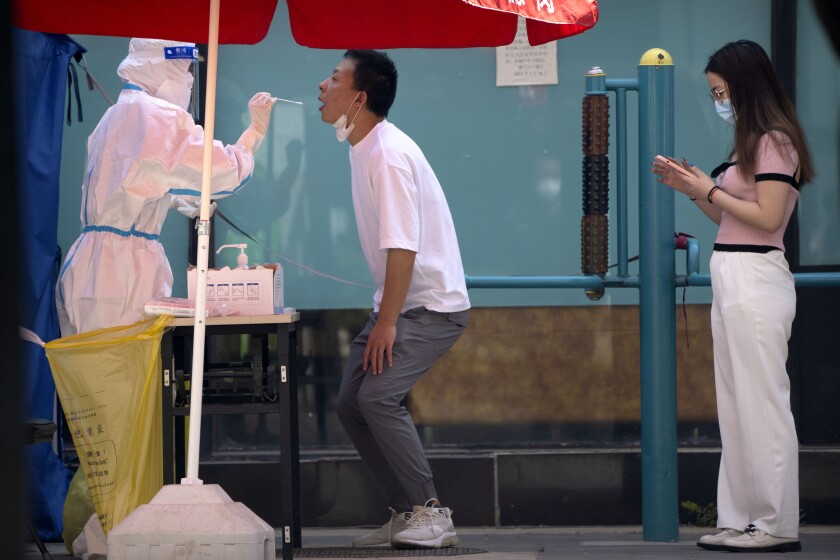
Beijing on Wednesday closed round 10% of the stations in its huge subway system as a further measure in opposition to the unfold of the coronavirus.
The subway authority mentioned in a short message that the measure to close 40 stations, largely in downtown Beijing, was being taken as a part of epidemic-control measures. No date for the resumption of service was given.
Beijing has been on excessive alert for the unfold of COVID-19, with eating places and bars restricted to takeout, gyms closed and lessons suspended indefinitely. Main vacationer websites within the metropolis, together with the Forbidden Metropolis and the Beijing Zoo, have closed their indoor exhibition halls and are working at solely partial capability.
A number of communities the place circumstances had been found have been remoted. Individuals residing in “managed” areas have been informed to remain inside metropolis limits, together with 12 areas deemed high-risk and one other 35 thought-about medium-risk.
Metropolis residents are required to bear three checks all through the week as authorities search to detect and isolate circumstances with out imposing the form of sweeping lockdowns seen in Shanghai and elsewhere. A destructive take a look at consequence obtained inside the earlier 48 hours is required to realize entry to most public areas.
Beijing on Wednesday recorded simply 51 new circumstances, 5 of them asymptomatic.
The subway closings ought to have comparatively little impression on metropolis life, with China observing the worldwide Labor Day vacation this week and plenty of commuters within the metropolis of 21 million already working from dwelling.
In a single downtown neighborhood categorized as high-risk, the streets had been virtually abandoned Wednesday other than a number of supply drivers on scooters and the occasional pedestrian and automotive.
All companies had been shut apart from supermarkets and fruit and vegetable shops. Outsiders usually keep away from high-risk areas to keep away from the likelihood that their go to exhibits up on the tracing apps put in on nearly all cellphones, which may create issues for his or her future entry to public areas.
Whereas taking a lighter contact in Beijing, China has general caught to its strict zero-tolerance strategy to COVID-19 that restricts journey, checks complete cities and units up sprawling services to attempt to isolate each contaminated particular person. Lockdowns begin with buildings and neighborhoods however turn into citywide if the virus spreads broadly.
That has prompted the most disruption in Shanghai, the place authorities are slowly easing restrictions which have confined many of the metropolis’s 26 million individuals to their flats, housing compounds or rapid neighborhoods for near a month, and in some circumstances longer.
Shanghai reported one other 4,982 circumstances Wednesday, all however 260 of them asymptomatic, together with a further 16 deaths. That continues a gentle decline in China’s largest metropolis, which recorded a each day peak of 27,605 new circumstances practically three weeks in the past on April 13.
The surprisingly low dying toll amid an outbreak of greater than 400,000 circumstances within the metropolis that's dwelling to China’s important inventory market and largest port has sparked questions on how such deaths are tallied.
The inflexible and broadly derided restrictions have led to shortages of meals and medical support together with a wider — although doubtless momentary — impression on the nationwide financial system. Determined residents have confronted authorities at barricades and on-line, screamed out of their home windows and banged pots and pans in an indication of their frustration and anger.
Communist authorities who tolerate no dissent have sought to clean such protests from the web and blamed the protests, together with the banging of cooking implements, on agitation by unidentified “overseas anti-China forces.”
As a part of its reopening, Shanghai this week started requiring well being establishments to completely resume companies wherever attainable.
At downtown Huashan Hospital, sufferers crammed the ready space with strains forming exterior some departments. Whereas affected person numbers are down by about two-thirds from earlier than the newest wave, their situations are usually extra critical.
Huashan’s chief of dermatology, Wu Wenyu, mentioned he was seeing sufferers who had delayed therapy due to the outbreak, some from cities exterior Shanghai.
“For instance, a affected person affected by shingles will harm very a lot. She or he might need felt very dangerous at dwelling, however she or he couldn’t go to the hospital as a result of COVID,” Wu mentioned. “However now many sufferers are coming to see the physician.”
Hospital directors mentioned the hospital was staggering appointments to keep away from crowding.
In some residential communities, a single member of the family was permitted to enterprise out twice every week to buy, typically additionally selecting up gadgets for neighbors.
Ling Jiazhao, supervisor of a grocery store in Shanghai’s jap Pudong district, mentioned the shop was limiting prospects to 50 at a time.
“I’m hoping it received’t trigger congestion. Every group has two to 4 hours to exit for buying, so most members will full that inside one hour,” Ling mentioned.
Post a Comment