Abandon hope, Dante famously forewarned.
Allow us to now, 702 years for the reason that publication of “The Divine Comedy,” depend the methods: the ceaselessly Omicron, local weather change, nuclear saber-rattling.
It was nearly precisely three years in the past that Thomas Adès’ wondrously anarchic and entertaining “Inferno” had its premiere, a fantastical spotlight of the Los Angeles Philharmonic’s centennial season. Again then, discovering good comedy in our human frailties appeared doable. Meant as the primary a part of an evening-long “Divine Comedy” ballet choreographed by Wayne McGregor for Britain’s Royal Ballet, the danced “Inferno,” which had its premiere on the Dorothy Chandler Pavilion a month later, turned a darker work. It was nonetheless filled with vivid cheek, if a bit creepier.
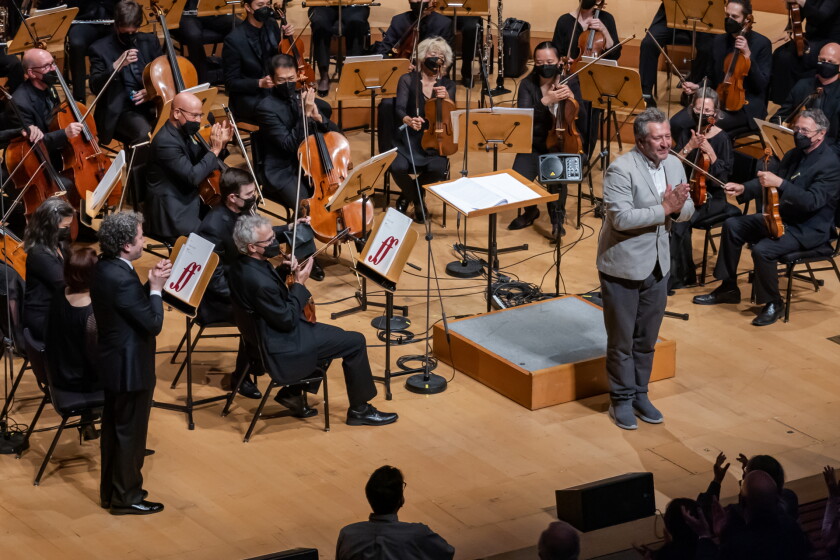
Throughout lockdown Adès completed the ultimate two elements, “Purgatorio” and “Paradiso,” with the whole work given its premiere by Royal Ballet in London final October as “The Dante Mission.” The total orchestral rating, merely known as “Dante” and commissioned by the L.A. Phil, had its live performance premiere final weekend as the principle occasion within the orchestra’s Gen X competition curated by the 51-year-old British composer.
On the hopeful time of the competition’s planning final 12 months, spring 2022 appeared like a time of renewal after we would lastly be past the pandemic, presumably at peace and with the opportunity of a newly enthused world cooperation to fight world warming. We all know how all that’s turned out.
Right here’s how “Dante” (because the orchestral rating for the total ballet is titled) turned out. In “Inferno,” carried out by Gustavo Dudamel with hair-raising vivaciousness, we discover ourselves taking alarming pleasure over our ridiculous neighbors, politicians, scammers, you identify ’em, coming to hilariously terrible no good. Within the second half, we notice the joke is on us. Humanity is what was at stake for Dante and what's at stake for us. “Purgatorio” and “Paradiso” are the place we discover our angels, and they don't seem to be the place you suppose they're.
In any new shortlist of nice ballet scores by Tchaikovsky, Stravinsky, Bartók, Ravel, Prokofiev, Britten and Bernstein, “Dante” should newly be included for its musical invention alone. There may be not a second in its 88 minutes that doesn’t delight. All of it's sudden and wished. However what's most sudden and wished proper now's Adès’ extraordinary abandoning of abandoning hope.
He units the tone although the magnificently malicious parody of “Inferno.” All these deviants and devious fortune tellers, popes and gluttons writhing in slime, the egocentric eternally stung by wasps and thieves devoured by reptiles haven't any means out. And but they're superb.
Utilizing Liszt as an extravagant mannequin and additional fortunately drawing from or remodeling Ravel, Mussorgsky, Dowland and others, Adès revels in his personal distinctive extravagance. In humorous methods, each ha-ha and curious, Adès’ music is all these issues Dante’s hell punishes. It's the whirlwind. It faces, just like the fortune-tellers, two instructions directly (right here, previous and new). Magnificence, pleasure, ferocious creativeness and astonishing talent aren’t ethical judgments, however they're the methods of creative illumination.
For the ballet’s second half, Adès abandons Lisztian revelry. “Purgatorio” relies on the Syrian cantorial custom. The scene of Dante’s approaching purgatory at daybreak turns into morning in Jerusalem on the Nice Synagogue Ades of the Wonderful Aleppo Neighborhood. There may be what sounds just like the recording of waves at sea and the singing of a cantor, his voice time-worn and timeless, his spirit hovering.
Recordings of the cantor, and of an ecstatic congregation, lead the ascent by dance and prayer, the orchestra getting into into its personal jumpy or sorrowful klezmer-like riffs. For 27 minutes you're transported to a world distant — the synagogue is the middle of what's left of the Syrian hazzanut fashion of singing. In Adès’ arms, it's this very transportation outdoors of our personal experiences to an historic and preservable realm that relieves a listener of expectations.
Like “Purgatorio,” “Paradiso” is 27 minutes. It takes a hazzanut melody and spins it out alongside an out-of-body journey previous moon, Mercury, Venus, solar, Mars, Jupiter, Saturn and distant mounted stars. The stellar our bodies will not be given specific character. We’re those spinning, the music goes nowhere. But within the going nowhere, you could be propelled by an power of quiet ecstasy.
Motion and time really feel suspended in stasis. The 27 minutes imply nothing. All through the rating, Dudamel’s conducting on the Saturday evening efficiency had by no means been extra virtuosic. However what proved most spectacular was his depth of that stasis, the sensation that this music was sourced by a sorcerer.
The arrival is at empyrean, introduced by a hidden, mystic Los Angeles Grasp Chorale. That the clichéd ending proved shifting past phrases turns into the final word sudden. Magical empyrean is mundane Earth. We’ve modified, not it.
The Gen X competition that surrounded “Dante” was mainly a gathering of Adès’ buddies. There wasn’t a lot talkin’ ’bout my era from the composers supposedly born between 1965 (the 12 months of the Who’s hit “My Technology”) and 1980. In a brief program observe, Adès prompt that if there's one huge factor about inventive Gen X artists, it's “that there isn't a one huge factor.”
“Who needs to be put in any type of field,” he concluded, “be it a ‘era,’ or a begin and finish date?” So he fudged with beginning dates slightly at each ends.
Within the unboxed first evening of the competition, wherein Adès carried out the L.A. Phil and appeared as pianist in a post-concert recital with violinist Pekka Kuusisto, no two works or composers have been alike.
That would imply the invigoratingly direct orchestral stomping of Anna Meredith’s “Nautilus” or the distorted musical symmetries Felipe Lara’s “Brutal Mirrors” impressed by Mauro Restiffe’s images of Soviet Russia structure. Veronika Krausas’ “Caryatids” gave charismatic sonic coloration, character and sensual physique to the feminine figures on foundational columns present in classical Greek temples which might be nonetheless employed right now. Francisco Coll made fashionable his personal Spanish folks and flamenco traditions in “4 Iberian Miniatures” for violin and orchestra, with Kuusisto as agreeably flamboyant soloist.
Adès put his personal wondrously whimsical spin on previous English dances in his newly orchestrated “Märchentänze” (Dances From Fairytale), which additionally featured Kuusisto as soloist. In a single dance, “A Skylark,” the solo violin is joined by an organized chaos of orchestral violins, mimicking particular person birds swooping all the way down to earth, as skylarks do, after which hovering away as Adès additionally does in “Dante.”
A second orchestral program carried out by Teddy Abrams included a blazing efficiency of the primary motion of Andrew Norman’s dazzlingly daffy “Play” and a loving one to Jonathan Bailey Holland’s mild ghostbuster, “Tales From Dwelling,” an ode to a Cincinnati live performance corridor.
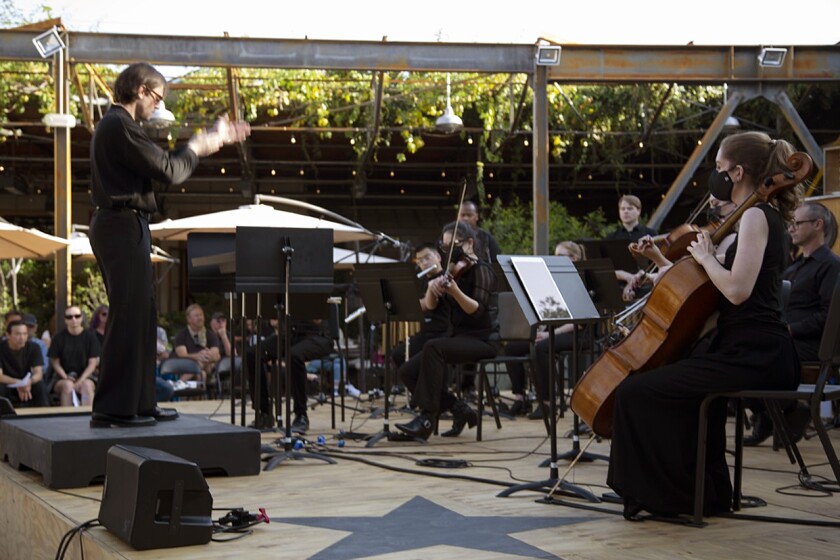
I left that Sunday matinee live performance at intermission (the second half was 84-year-old John Corigliano’s Symphony No. 1) and headed to the Arts District for the West Coast premiere of Gen X-er Tyshawn Sorey’s “For George Lewis” within the courtyard of Hauser & Wirth. This was a part of a free Monday Night Concert events on a uncommon Sunday afternoon live performance placed on at the side of Gary Simmons’ exhibition “Recapturing Reminiscences of the Black Ark,” for which Holland’s rating would have additionally been related.
Sorey’s 50-minute chamber orchestra rating strikes with sluggish, beautiful, out-of-the-box Gen X deliberation. Sarcastically, it was written for and recorded by the New York new music group Alarm Will Sound, which was taking part in two extra Gen X composers in a post-concert L.A. Phil program at Disney across the similar time.
At Hauser & Wirth, although, Jonathan Hepfer led the ECHOI ensemble with unalarming effervescence. This was open air. The solar beat down and house within the shade was restricted and fought over. The courtyard restaurant was noisy. But that sluggish going nowhere felt unexpectedly and specifically illuminated, as if proper at house in Adès’ world.
In August, Sorey and Adès would be the featured composers on the Lucerne Competition and share a program. With Gen X, no huge factor could be a very huge factor.
Post a Comment