
Warmth waves. Extreme drought. Excessive wildfires.
As Southern California braces for unprecedented drought restrictions, long-range forecasts are predicting a summer season that will probably be fraught with record-breaking temperatures, sere landscapes and above-average potential for vital wildfires, notably within the northern a part of the state.
“The cube are loaded for lots of massive fires throughout the West,” stated Park Williams, a local weather scientist at UCLA. “And the rationale for that's easy: The overwhelming majority of the western U.S. is in fairly critical drought.”
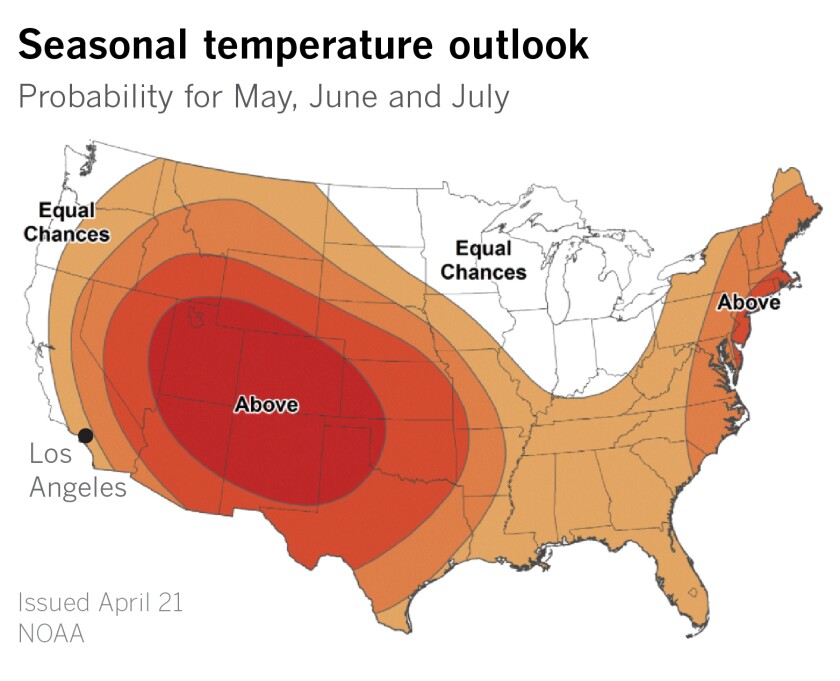
Not too long ago, the Nationwide Oceanic and Atmospheric Administration stated the temperature outlook for the transition from spring into summer season this yr requires above-normal readings for many of the West.
On the similar time, the company additionally reported that whereas long-range forecasts had steered the local weather phenomenon referred to as La Niña was dissipating — elevating a glimmer of hope that California would possibly expertise a standard winter in 2022 — it now appeared that the “little woman” was hanging on, presumably into a 3rd yr.
If NOAA is right, excessive temperatures and the lingering La Niña can have main impacts on city and agricultural water use throughout the American West, in addition to for California’s more and more excessive hearth season.
Already, the federal authorities has introduced that it's going to delay water releases from Lake Powell, the nation’s second-largest reservoir, because of worsening drought situations alongside the Colorado River. In an effort to spice up the shrinking reservoir, the U.S. Bureau of Reclamation stated Tuesday that it plans to carry again water to cut back dangers of the lake falling beneath a degree at which Glen Canyon Dam would now not generate electrical energy.
Not like its wetter and higher recognized sibling, El Niño, La Niña usually brings dry winters to Southern California and the Southwest.
Now, with California’s wet season largely within the rearview mirror and a sizzling dry summer season quickly approaching, forecasters say La Niña has a 59% probability of continuous by the summer season, and as much as a 55% probability of persisting by the autumn.
Consultants say this summer season could possibly be a repeat of final yr, when fires burned greater than 2.5 million acres throughout California — greater than every other yr besides 2020.
“Final yr, one factor that made the fireplace season particularly energetic have been the acute warmth waves that occurred throughout the West throughout summertime,” Williams stated. “So we’re in the same state of affairs this yr, the place we’re going into summer season with extraordinarily dry situations, however we don’t but know whether or not there are going to be extra file warmth waves this yr. That’s why there’s nonetheless plenty of uncertainty in how the fireplace season is definitely going to play out.”
Warming of the planet as a result of human exercise has elevated the probability of extreme warmth waves, and warmer temperatures additionally worsen drought by inflicting snowpack to soften earlier within the yr, and inflicting extra precipitation to fall as rain, as a substitute of snow.
“The probabilities of having record-breaking warmth waves this yr are larger than regular,” Williams stated. “However there’s nonetheless room for hope that we get fortunate.”
Already this yr, California has seen 1,402 fires which have collectively burned 6,507 acres. That compares with 1,639 fires that burned 4,779 acres presently final yr, stated Capt. Chris Bruno of the California Division of Forestry and Hearth Safety.
Cal Hearth is presently holding trainings in all its applications, from helicopter rescues handy crews, and is bringing on seasonal staff to assist operations with an eye fixed towards reaching peak staffing — which averages 10,000 staff — by June or July, he stated.
La Niña’s refusal to maneuver on may additionally trigger issues for locations apart from California.
La Niña influences local weather across the globe, and is cyclical. It might carry drought to some components of the world concurrently it brings torrential rain to others.
“Each La Niña and El Niño are main disturbances in ‘the drive’” stated climatologist Invoice Patzert. Some climate disasters all over the world have been blamed on local weather change however are literally typical of the La Niña impacts we’ve seen previously, though they could be intensified or modified by warming introduced on by the burning of fossil fuels, he stated.
“La Niña and El Niño have at all times had giant international footprints,” Patzert stated.
Whereas California had its driest January, February and March on file, Alaska and the Pacific Northwest have been moist. Throughout the Pacific Ocean, Australians have been fleeing file flooding. Extended drought gripped equatorial jap Africa, elevating the specter of famine for tens of millions of individuals within the Horn of Africa. On the similar time, components of South Africa, similar to Durban, obtained file rainfall. Torrential downpours triggered flooding and landslides in Rio de Janeiro.
There are different influences as nicely. La Niñas normally weaken wind shear within the Caribbean and tropical Atlantic, contributing to elevated hurricane exercise within the Atlantic Basin. Each 2020 and 2021 have been energetic hurricane seasons, with 2020 going into the file books because the yr with essentially the most named storms of any season on file.
This yr, forecasters at Colorado State College have predicted 19 named storms, together with 9 hurricanes. This may be the
seventh consecutive above-average Atlantic hurricane season, in response to Patzert.
Within the northern United States, La Niñas are usually related to colder, stormier-than-average situations and elevated precipitation. Within the southern U.S., they’re recognized for hotter, drier and fewer stormy situations.
Fortunately, La Niña doesn’t final eternally.
Each La Niña and El Niño are half of what's referred to as the El Niño Southern Oscillation, or ENSO. Between them is a impartial section, which is what forecasters had thought we have been headed towards this spring.
Within the meantime, forecasters say, the dryness within the western U.S. has a silver lining, a minimum of for Southern and Central California. Whereas the Nationwide Interagency Hearth Middle is predicting that a lot of the northern portion of the state will see an above-normal potential for vital fires by August, meteorologists are calling for near- to below-normal hearth exercise within the southern reaches.
That’s as a result of there hasn’t been sufficient rain to develop the grasses that usually function gasoline for Southern and Central California’s lower-elevation fires, stated U.S. Forest Service meteorologist Matt Shameson.
“I’d say the wonderful fuels are about ankle to calf excessive,” he stated. “Usually, they’re about knee to waist excessive.”
The area has seen no vital grass fires to this point this yr, which usually begin throughout the decrease elevations in the midst of April, he added.
Northern California has obtained extra rain, notably on the finish of March by April, so there's a extra sturdy grass crop, which helps unfold hearth by carrying it up into bigger fuels like timber, he stated. As well as, Northern California has extra vegetation generally, so fires there are usually not restricted by the quantity of gasoline accessible.
“I feel that this yr goes to just about mimic final yr — very related situations are anticipated,” Shameson stated. Southern California had fewer vital fires than common and noticed much less acreage burned, whereas Northern California shattered information, with the Dixie hearth scorching practically 1 million acres and burning throughout the Sierra Nevada for the primary time in recorded historical past.
“I can let you know: They’re anticipating one other large hearth season up north,” he stated.
The results of those repeated giant, extreme fires have the potential to be ecologically devastating and pose an actual threat of compromising the state’s local weather objectives, specialists say. The Sierra Nevada and Southern Cascade ranges, which presently retailer near half of California’s captured carbon, misplaced 1.1 million tons of saved carbon to wildfire, drought and invasive pests from 2018 to 2019 alone, in response to not too long ago printed analysis by scientists at UC Berkeley.
“That’s a 35% discount in only a yr,” stated writer Alexis Bernal, a analysis specialist at UC Berkeley’s Stephens Lab. “And we all know that these disturbances are solely going to extend in frequency and depth with local weather change.”
She and different scientists are calling for land managers to extend forest resiliency by thinning vegetation and growing the usage of prescribed fires to cut back the density of forests in order that blazes burn much less severely by them.
Absent intervention, she stated, it’s projected that the Sierra Nevada and Southern Cascade area will lose over 75% of its above-ground carbon shares by 2069, sending about 860 million metric tons of carbon dioxide into the air.
“Meaning the Sierra Nevada and Southern Cascade area will now not be a carbon sink, as it's now,” she stated. “It will likely be a carbon supply.”
Giant, high-severity burn patches can even end in ecosystem collapse by changing forests into grass and shrublands, she added.
“These landscapes could now not perform as forests anymore,” she stated. “They might perform as one thing else, which might be fairly devastating for all dwelling issues, together with ourselves, that depend on these forests to outlive.”
Post a Comment