
Ever pushed across the vastness of Larger Los Angeles and seen the freeway offramp for the city of Gladysta? Or Terracina? How in regards to the San Gabriel River city of Chicago Park — actually in the San Gabriel River?
When you noticed them, you won't have handed a Breathalyzer check. These cities by no means existed.
The county of Los Angeles embraces greater than 4,000 sq. miles. Inside these miles are actually 88 integrated cities, Los Angeles chief amongst them. However right here’s a vanishing act for you: There have been as soon as a minimum of 100 cities laid out right here, all able to welcome the massive wave of settlers from factors east who created the area’s large actual property increase simply over a century after the town was based in 1781.
Some have been precise burgs that grew and dwindled, have been annexed or swallowed up. Some have been “dream cities” imagined by actual property builders, deliberate and platted and offered, however by no means born. Bearing some fanciful names like Ivanhoe and Wahoo, some have been offered off with hopes and costs larger than their survival odds. Others have been peddled nearly as cynically as Florida swamplands: “ocean view” cities practically 30 miles from the ocean, and different “view” cities whose vistas have been desert desolation.
Between 1884 and 1888, actual property offered like mad, typically to newcomers who usually went from practice station to resort to actual property public sale. However the bubble collapsed, and inside a yr or two, 60 L.A. County cities had vanished.
Poof.

Explaining L.A. With Patt Morrison
Los Angeles is a posh place. On this weekly characteristic, Patt Morrison is explaining the way it works, its historical past and its tradition.
One city had a single forlorn resident hanging in. The builders’ white stakes marking boundaries of defunct cities have been as mocking as tombstones.
Phantom cities fall broadly into two varieties, the once-were and never-were.
The once-were have been bona fide townships and integrated cities that grew to become suburbs inside the metropolis of L.A. Eagle Rock, after 11 years as a metropolis, grew to become a part of L.A. in 1923. Hollywood lasted as a metropolis for simply seven years earlier than becoming a member of up with L.A. The best way it was described in “La Reina,” a 1929 promotional historical past of L.A., “Struggling for an ample water provide, Hollywood got here into [L.A.] in 1910.” A water provide, greater than some other consideration, made cities fold their arms and be a part of arms with L.A., the lord of waters.
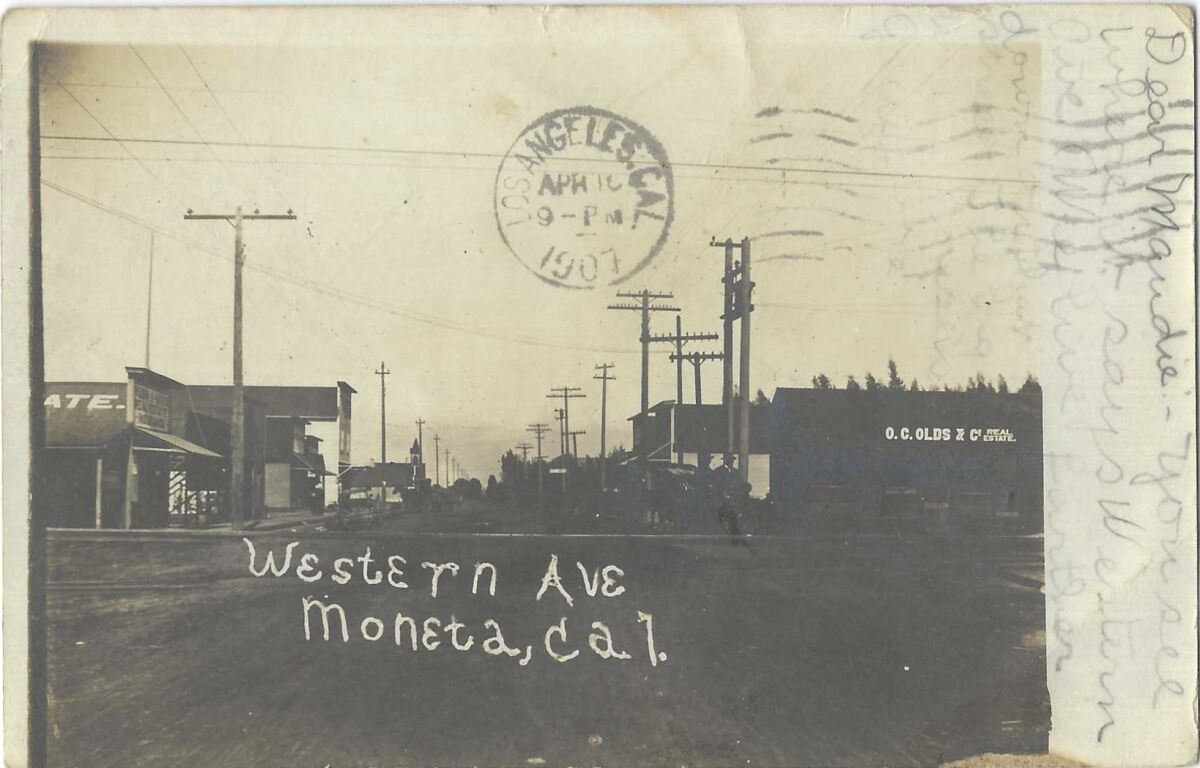
Moneta was a township, now a part of Gardena, that flourished from the flip of the century till World Battle II as a middle the place Japanese households farmed and shopped and went to high school; the neighborhood survives in reminiscence and applications on the Gardena Valley Japanese Cultural Institute, and in a number of Gardena companies calling themselves “Moneta.”
Tropico was a valiant little city wedged between L.A. and the southern fringe of Glendale. In February 1888, The Instances’ society web page famous that a Mr. M.O. Ayres and household, from Nebraska, have been “wintering in Tropico to flee the trials of their northern residence.” Tropico then was nonetheless a city of about 75 homes — it wasn’t integrated till 1911 — whose city marshal bragged that there was not “a single place the place liquor may be obtained in any form or method.” About 150 of Tropico’s 860 acres have been at one level dedicated to rising strawberries.
Tropico’s finish started when the prices of working the town grew too excessive, and in a tug of battle for its affections between L.A. and Glendale, the town voted in 1917 to pair up with Glendale, despite a warning within the Tropico Sentinel that “Tropico will grow to be the spouse” — that means the inferior — “on this wedding ceremony of cities.” Tropico’s favourite son? The acclaimed visionary photographer Edward Weston, who took photographs of the city and portraits of its residents, on the market at his studio, $5 for a dozen.
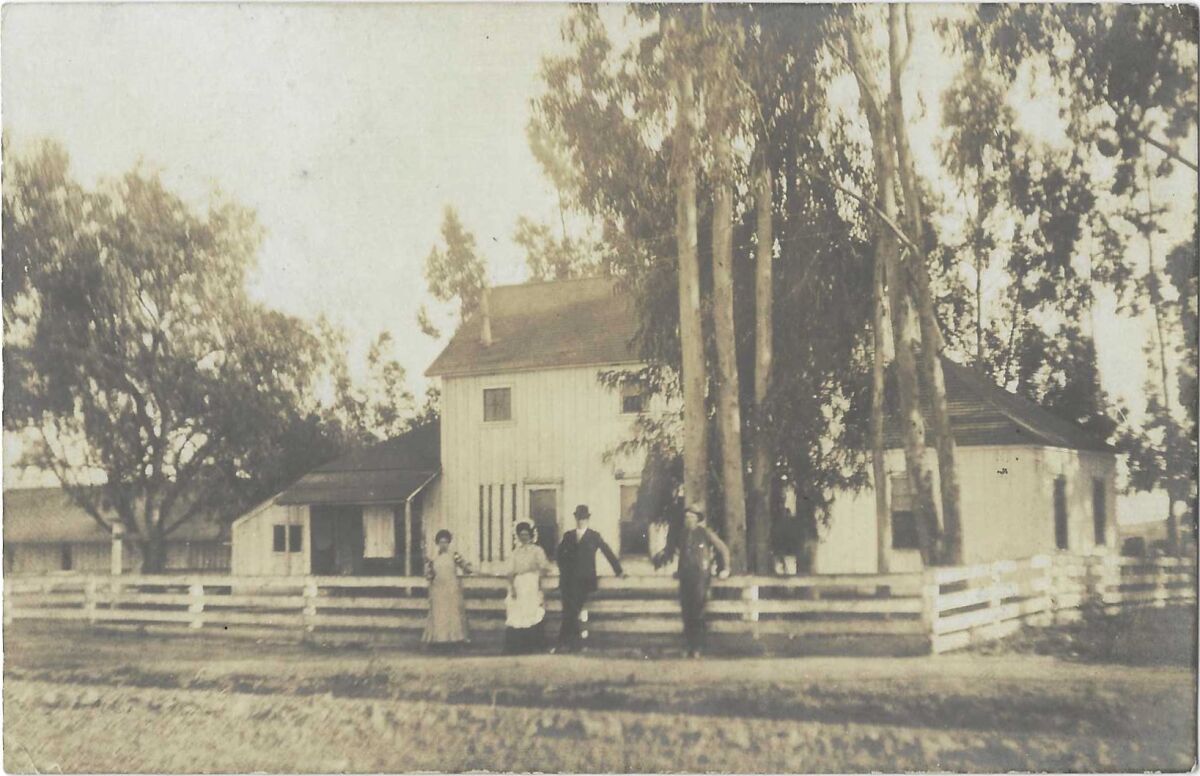
The onetime city of Hynes is now the town of Paramount — nicely, half of it. Hynes was a riverside dairy city and — laborious as it's to imagine now — the hay capital of the world, a minimum of by bragging measurement. With the neighboring city of Clearwater, it threw annual hay and dairy festivals. After World Battle II, as suburbanization made hay on the outdated hayfields the 2 joined below a brand new identify — Paramount. They fought over it for nearly two years, and it took some Solomonic doing to drag off. The Clearwater Chamber of Commerce and its ladies’s division balked, and a kind of who soothed harm emotions was Frank Zamboni, Kiwanis Membership chief and creator of the charismatic ice resurfacing machine that bears his identify.
Hynes had its personal nationwide financial institution, which was irresistible to a quartet of stick-up males in 1919. One of many 4 was an ex-soldier who, one yr earlier than, had been gassed when he was preventing within the battles of St. Mihiel and the Argonne in World Battle I. He wanted the cash, he stated, to marry his teenaged fiancee.
The never-were cities have been known as “dream cities,” which was wishful pondering, on condition that so a lot of them wound up as nightmares within the wreckage of the Eighties actual property increase.
The outright scams abounded, and few have been scammier than Simon Homburg’s. In about 1887, he purchased a few large hunks of land from the federal authorities, in mountains on the japanese fringe of L.A. County. One part he known as Border Metropolis, and the opposite Manchester. They have been so inaccessible that the land might solely be surveyed by binoculars, and reached, so it was stated, by balloon. The views Homburg bragged about have been of desert desolation. He haphazardly divided the land into parcels, 12 or 14 heaps per acre. Land that price him 10 cents per lot, he offered for $1 to $250 every, relying on the gullibility of the mark. Cannily, he didn’t promote the heaps domestically, the place individuals may know the lay of the land, however to Easterners and even in Europe. He managed to make himself about $50,000.
Hesperia is a Excessive Desert metropolis with a stunning identify from Greek mythology, however its origins have been savagely mocked by a spiky nineteenth century pioneer and newspaperman named Horace Bell. One other pioneer, named Joseph Widney, had purchased up quite a lot of land round Hesperia, and Bell parodied, however perhaps not by a lot, the gross sales strategies of such increase brokers as a “speculative conspiracy towards all that was sincere.”
Just like the land barkers themselves, Bell too laid it on thick about “Widneyville-by-the-Desert.” There, he wrote, promoters “did somewhat even handed trimming” of the Joshua timber, “then shipped out a carload of low-cost wind-fall oranges and on the top of every bayonet-like spike on the yuccas and on every cactus backbone they impaled an orange. All of the sudden the desert fruited just like the orange grove! ... The Easterners stood agape on the Elysian sight” and have been mesmerized by the spiel in regards to the faculty, the church buildings, the sanitarium and the resort “that will quickly encompass the central plaza of Widneyville,” together with irrigation canals that will quickly develop oranges “as large as pumpkins. There’ll be a fortune in each block, girls and gents.”
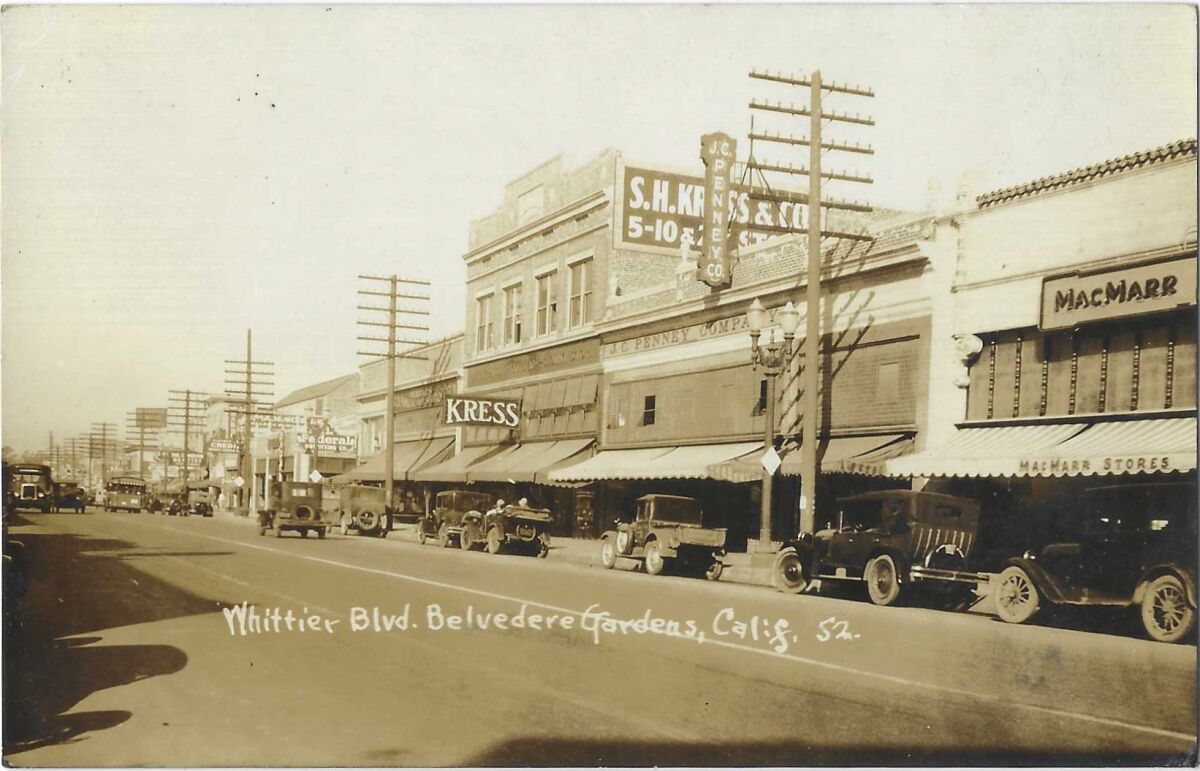
Belvedere Gardens was a growth tract round Whittier Boulevard east of downtown that, after World Battle I, grew to become a neighborhood and a middle of Latino life and tradition — colleges, retailers, neighborhood and non secular occasions. Like a lot of L.A.’s Latino Eastside, together with the close by hamlet of Belvedere, it grew to become encircled by freeways.
Different names could also be acquainted to you as streets, but they're the remnants of cities or plans for cities.
Sawtelle, named for a land growth firm’s supervisor, is not any extra, however the trendy VA hospital and remnants of the outdated troopers’ residence stay. And like Moneta, Sawtelle was a deeply rooted neighborhood for Japanese Angelenos.
Sawtelle had a shotgun marriage with L.A. Towards the top of World Battle I, metropolis fathers resisted Sawtelle voters’ three-margin “sure” vote to becoming a member of L.A. So L.A. got here in and carted off the town secure, the town seal, and even metropolis corridor lightbulbs. Sawtelle’s rump council thereafter met in somebody’s residence. The battle went on for a number of years. After the state Supreme Court docket sided with Sawtelle metropolis fathers, L.A. took its fireplace hose and municipal furnishings and decamped. The transient, candy victory resulted in 1922 when Sawtellians voted by about three to 1 to return to L.A.’s civic embrace.
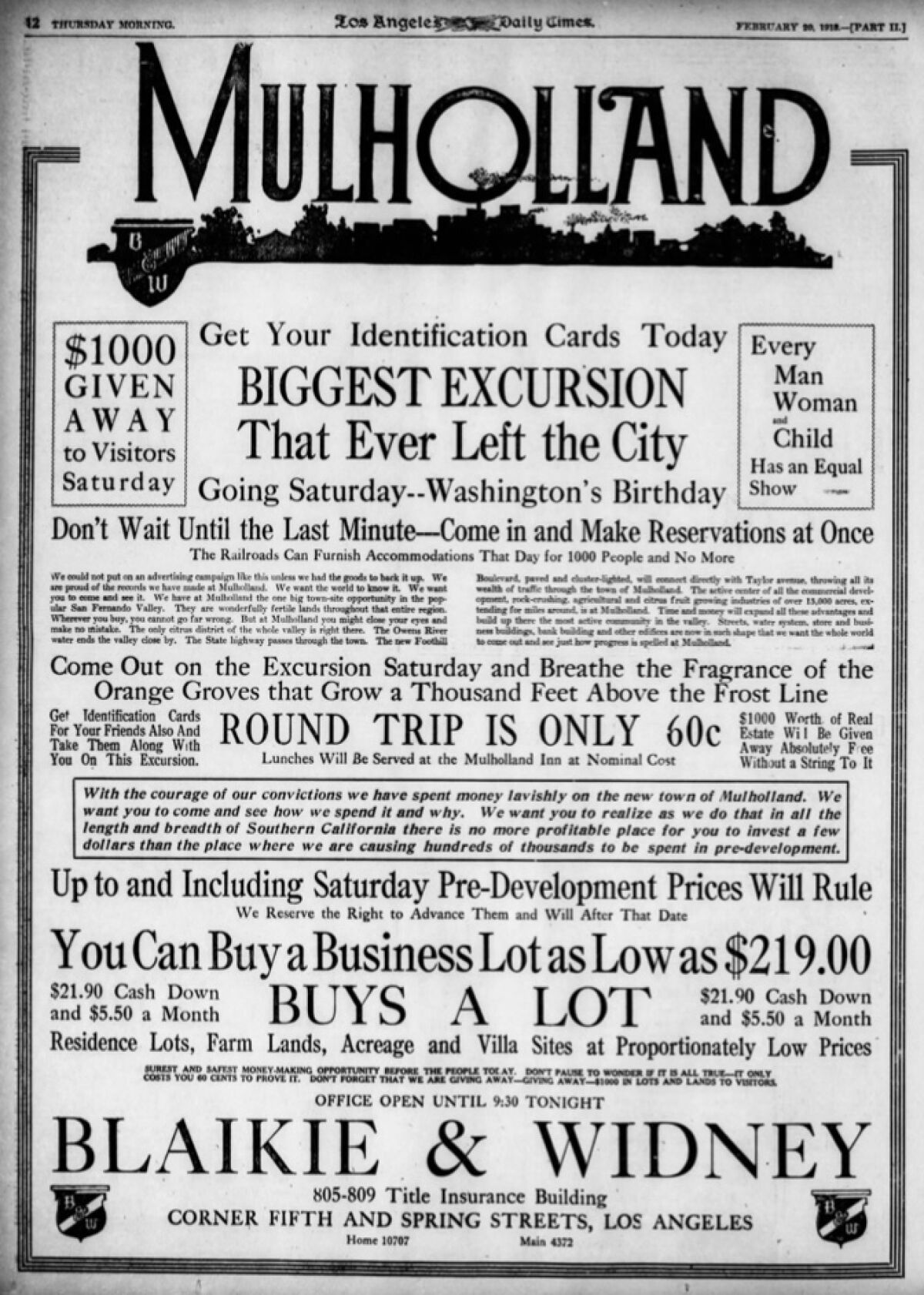
The city of Mulholland — nicely, everybody is aware of Mulholland Drive, if not the person William Mulholland himself. The city of Mulholland existed largely in exuberant gross sales pitches. 9 months earlier than water cascaded to the L.A. finish of the aqueduct constructed by William Mulholland, The Instances was already promoting the city of Mulholland as “the pay roll city of the San Fernando Valley.”
Lankershim rings a fainter bell, extra seemingly for the boulevard than for the pioneering Lankershim farmers and builders, father and son. The city based in about 1893 vacillated between names — Lankershim! No, Toluca! — however in 1906, Lankershim received. Till 1927, when the entire shebang grew to become North Hollywood.

Garvanza — a garbled supply of “garbanzo,” for an area crop — was the identify for the nice pocket of valley and hills on both aspect of what's now Avenue 64 in Highland Park, created as a city in 1886 and annexed by L.A. in 1889. Its chief decoration then and now could be the chic stone Church of the Angels, constructed the identical yr that L.A. annexed Garvanza, however the divvy put it on the Pasadena aspect of the road.
Colegrove, a city that abutted Hollywood to the south, bore the identify of the founder’s spouse, Olive Colegrove. Cornelius Cole was a two-term California senator and confidant of Abe Lincoln’s, and as fee for a victory in a large land dispute, his consumer, Henry Hancock, paid him with 500 acres that Cole settled and subdivided. The city was annexed to Los Angeles in 1909, and Cole died in his home in 1924 at 102, the longest-ever-living U.S. senator.
Colegrove’s transient ethical panic, in 1904, was triggered when Pearl Morton, a infamous madam whose enterprise deal with was in downtown L.A., constructed herself a personal, $12,000 home on the nook of Santa Monica Boulevard and Wilbur Road. It didn’t take too a few years for a civic cleanup marketing campaign to ship her packing for San Francisco’s much less censorious neighborhoods.
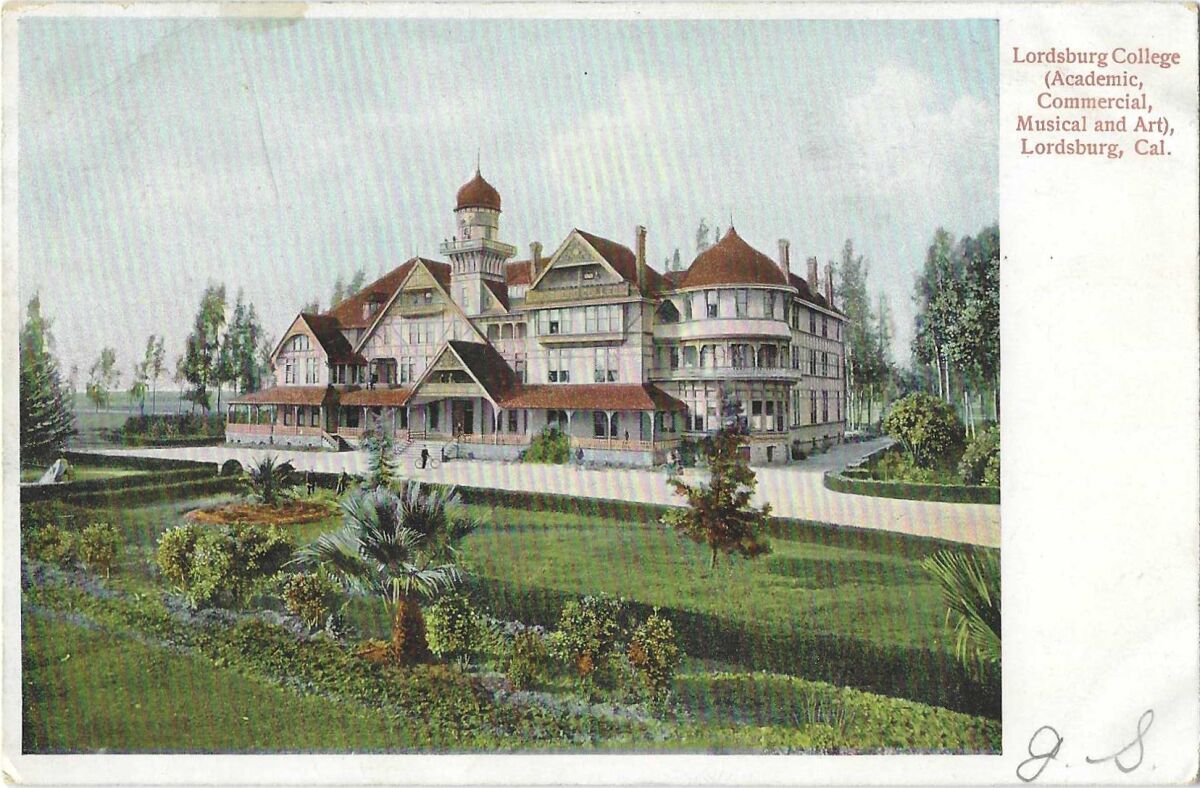
Lordsburg — you already know it as La Verne — was a kind of basic “boom-to-bust” Eighties cities, constructed with a resort to entice settlers who by no means got here. The resort was reborn as a spiritual faculty, the forebear of the College of La Verne. The city’s founder, Isaac Lord, was himself scammed out of virtually $10,000 by a flimflam man nicknamed Insurgent George, who promised to take a position it in a gold mine and left Lord and a good friend holding the bag — a pile of gilded lead items.
All of this seemingly left Lord a cranky man, and when Lordsburg requested its largest landowner for permission to vary its identify to La Verne, he balked. Solely after he died, in 1917, did Lordsburg grow to be La Verne, with a symbolic civic wedding ceremony between “Miss Lordsburg” and “Mr. La Verne.”
Owensmouth was the city on the outfall finish of the Los Angeles Aqueduct, and a tombstone tribute to Owens Valley, which was left actually excessive and dry when L.A. introduced its water south in 1913. Paradoxically, Owensmouth itself pumped groundwater for its wants and didn’t get any of that aqueduct water till it agreed at hand over its civic keys to L.A. in 1917. It grew to become the neighborhood of Canoga Park. One of many books by Catherine Mulholland, granddaughter of aqueduct engineer William Mulholland, was known as “Owensmouth Child: The Making of a San Fernando Valley City.”
Regardless of the pitch, regardless of the hype, all of it started and sometimes ended with water.
Within the crazed yr of 1887, the “specter metropolis” of Chicago Park was specified by the dry wash of the San Gabriel River — 2,289 heaps, apparently offered for $13 every, in accordance with the eccentricities of the developer. Posters promoting the gross sales confirmed steamers merrily plying the imagined waters of the river. However quickly sufficient, because the 1916 “Southern California Quarterly” pronounced, the river “arose in its wrath and transformed Chicago Park right into a maritime metropolis by washing its soil and silt into the San Pedro Harbor, forty miles away.”
5 years later, these many a whole bunch of a lot of Chicago Park have been valued by the county assessor at $1 — for a bundle of 5.
Post a Comment