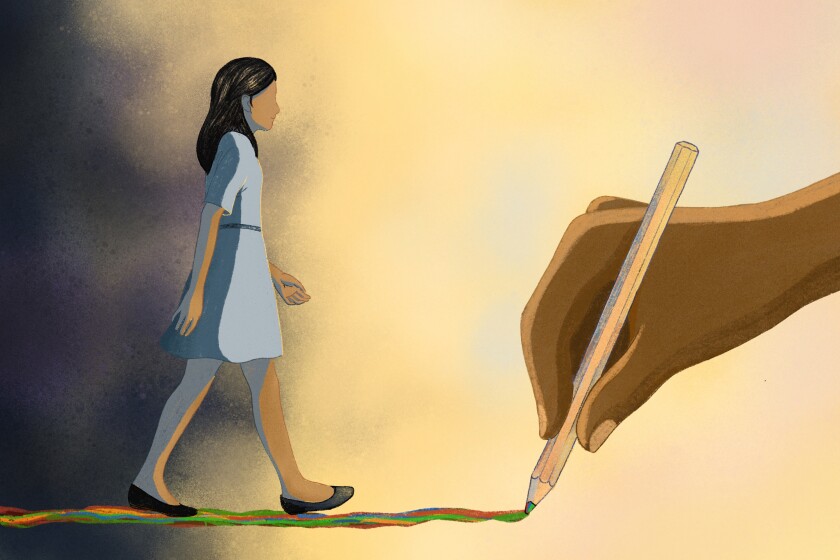
“You're South Asian,” I inform my daughter, Minal. “100%. And you're additionally 100% Chicana. You're each.”
Minal, a junior at a Pasadena public highschool, rolls her eyes. After two years of isolation in the course of the pandemic and our household’s current relocation to a metropolis the place we now have no household and are solely simply forming neighborhood, she is way from her roots.
My husband, René, and I've tried to go down a world consciousness that hyperlinks her twin identities. She has attended worldwide baccalaureate and Spanish immersion faculties, and household on each side are an enormous affect. In a current essay about her household historical past, she concluded that each her mother and father’ ancestors “skilled displacement of their lives due to colonization.”
Throughout many dinnertime conversations at my mother and father’ home in Karachi, Pakistan, she has heard my mother and father, my journalist sister and a spate of company focus on politics. She, too, counts as a product of the feminist and agnostic house through which I used to be raised. And my mom, a veteran educator, is an everyday customer to our Pasadena house.
René is a Chicano from the Texas Rio Grande Valley, the place his household remained for generations even because the border shifted between Texas and Mexico. His older sister — one of many pioneers of Chicana literary criticism — begins household meals (usually Tex-Mex or Chinese language takeout) by dedicating gatherings to ladies and Indigenous communities.
René and I met in Austin. I had not deliberate to stay within the U.S. after graduate faculty, however we related over our worldviews and household histories solid by shifting borders and displacement. We created a neighborhood in Houston the place we lived for 20 years earlier than shifting to Pasadena for work.
As a transnational — somebody with properties throughout borders — I stay near my household in Karachi, the place I don’t have to elucidate my id. Nevertheless, within the U.S., the superficiality of pores and skin coloration and the assumptions that individuals make about each other are actual points. As soon as in Houston, when Minal was 2, I used to be speaking on my cellphone whereas pushing her stroller. A white girl yelled at me, maybe considering I used to be Minal’s nanny: “Get off your telephone and maintain the infant.”
Extra lately, I used to be with two author associates in an outside cafe in Mid-Metropolis L.A. A lady walked as much as us. Her eyes pinned on me, she commented how she appreciated my T-shirt that learn “Resistencia: Poets In opposition to Partitions” (a writers’ collective in south Texas). Then she requested: “The place are you from?” I informed her that I had moved to L.A. from Houston.
“However the place are you actually from?” she pushed.
My associates cringed for me. One had mother and father from Czechoslovakia and Ecuador. The opposite was born in Hawaii and had Irish and Japanese roots. However due to my darkish pores and skin, the query was posed solely to me.
Since relocating to Pasadena, I’ve taught storytelling workshops for youngsters by the varsity district. The scholars who outline themselves as multiracial, more and more with mother and father who're each folks of coloration, perceive the that means of intersectionality as Minal does. I’ve discovered that Gen Z teenagers will declare their identities when requested. In the event that they really feel secure, they title their mother and father’ ethnicities — Black, Latinx, Indigenous, white, Asian — and most add in international locations the place their mother and father have been born. They record different labels which might be vital to their identities: queer, trans, nonbinary, bisexual, girl, cis. Many additionally notice their passions: athlete, musician, author, singer, activist and extra.
In my writing workshops, college students are sometimes on the lookout for paths to inform their tales, which aren't mirrored of their textbooks. One scholar, who identifies as white and Japanese, wrote about battling how her friends noticed her: “Too Asian for the white youngsters. Too white for the Asian youngsters. Teased regardless.”
However Minal’s challenges are distinctive to her expertise; nobody we all know has walked her path as a Chicana-South Asian with prolonged household scattered across the U.S., Pakistan, India and the globe.
I've no solutions for her as she explores the place she belongs in a brand new metropolis. As her mom, I've to belief that she is going to discover solutions for herself. For now, René and I create alternatives for her to attach with household, which we took without any consideration rising up. All I can do is take heed to Minal and say — as I do to my college students: “You need to inform your personal story.”
Over the winter break, Minal and I braved Omicron and flew to Karachi for a couple of weeks. Experiencing the town for the primary time as a younger grownup, Minal hung out together with her cousins, one in every of whom can be biracial and U.S.-born, whereas the opposite was born in Pakistan and divides her time between the U.S. and Karachi. Minal reconnected with prolonged household, our home, the markets and the seaside. And although she feels self-conscious when talking Urdu, she might comply with conversations.
Late one evening, I heard voices from my previous bed room the place Minal was together with her cousins. I used to be about to faucet on the door to remind her of the early morning outing we’d deliberate. I couldn’t inform what the women have been saying, however a peal of laughter lower previous the door. I walked away with out knocking. Her time with household in Karachi, Austin and Southern California — the place our household unit is forging a brand new path — would possibly inform her in ways in which textbooks by no means can.
Sehba Sarwar is a author primarily based in Los Angeles and the writer of the novel “Black Wings.”
Post a Comment